Black Poetry Day
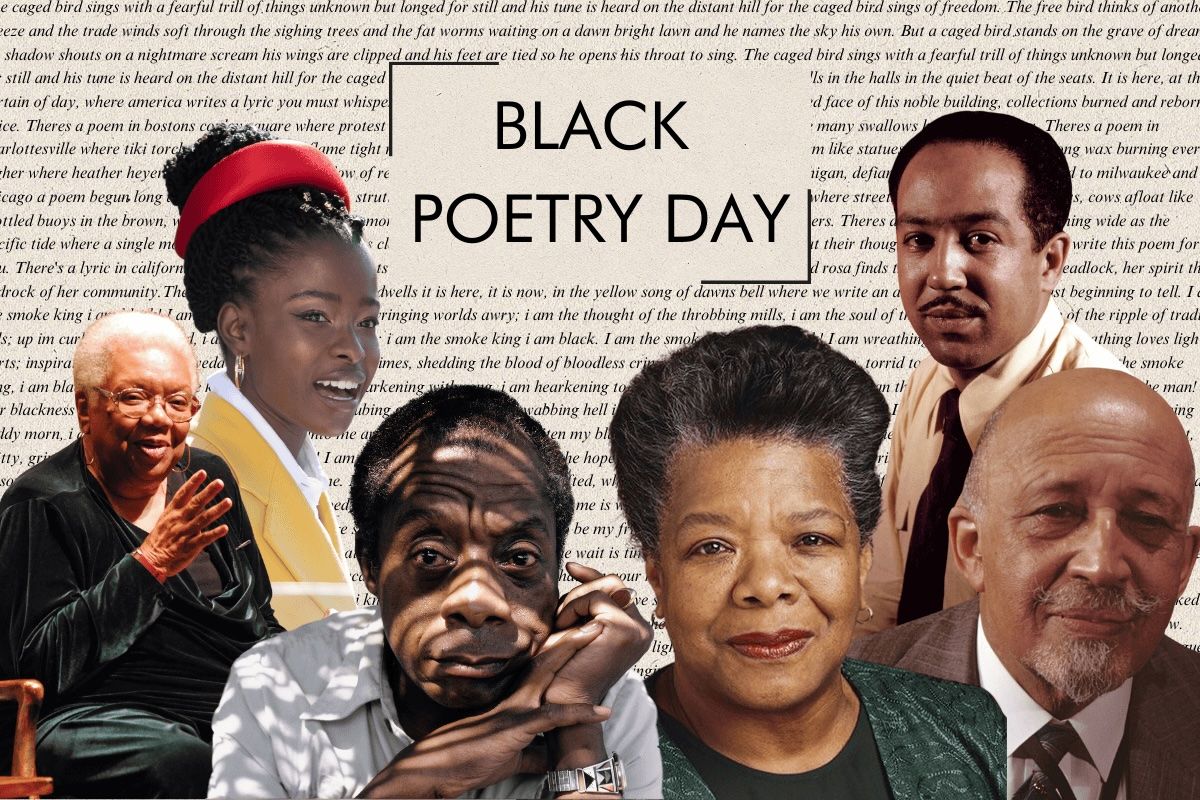
A collage image with the words “Black Poetry Day” front and center with images of, from top left, clockwise, Langston Hughes, W.E.B. DuBois, Maya Angelou, James Baldwin, Lucille Clifton, and Amanda Gorman. Image created by the American Writers Museum to highlight their wealth of resources for Black Poetry Day.
Every year on October 17th, readers across the country celebration Black Poetry Day, a celebration dedicated to the contributions of Black poets throughout history. The date marks the birthday of Jupiter Hammon, the first published Black poet in the United States, born on October 17, 1711.
Born into slavery in Long Island, New York, Hammon had a unique opportunity not afforded to other enslaved people. The Lloyd family, his captors, had deep ties to Anglican and Congregational churches, which encouraged teaching enslaved people to read the Bible. Because of this, Hammon was given access to the estate's library and received an education alongside the Lloyd children.
In many parts of the country, especially the South, anti-literacy laws were in effect to stop enslaved and freed Black people from learning to read or write.
The fear was that education would make enslaved people feel like they were members of society, or that it could give them the skills to organize and rebel. Enslaved and freed Black people created their own secret ways to learn, but writing was especially difficult to master independently because parchment, ink, and other supplies were expensive and hard to come by.
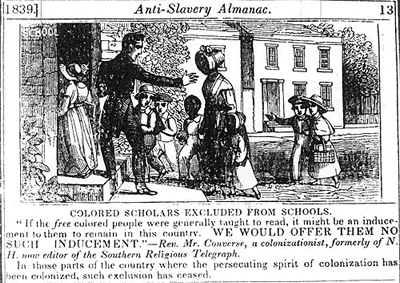
A black and white image of a newspaper clipping from 1839 issue of the Anti-Slavery Almanac, which includes a drawing of a white person refusing a Black family access to a school while other white people walk inside. The text below it includes the following quote from Reverend Mr. Converse: "If the free colored people were taught to read, it would be an inducement for them to stay in the country. We would offer them no such inducement." Image Source: Wikimedia Commons
Hammon became a distinct and influential voice as a poet. His published writing was rooted in his religious studies and reflected the sermons he gave as a preacher to other enslaved people on the Lloyd estate. Some critics dismiss his work for not addressing slavery, but undiscovered poems found since indicate that those simply weren’t the ones that got published. And, woven through all of his works are nuanced codes, language meant only for abolitionists and literate Black people, that communicate his true feelings about white supremacy and slavery. His first published poem, "An Evening Thought: Salvation by Christ, with Penitential Cries," made him the first Black writer to be published in the United States. In 1787, he delivered a speech called "An Address to the Negroes in the State of New York" to the African Society of New York City. In it, he urged Black Americans to pursue literacy through reading the Bible, writing that if there were no Bible, reading would hold no value at all.
Hammon was one of only two known Black writers published in North America during the 18th century. The other was Phillis Wheatley, born around 1753, who became the first published Black American female poet and only the third American woman to publish a book of poems. She was born in West Africa, enslaved when she was about seven, and brought to Boston, where the Wheatley family educated her in English, Latin, Greek, and literature.
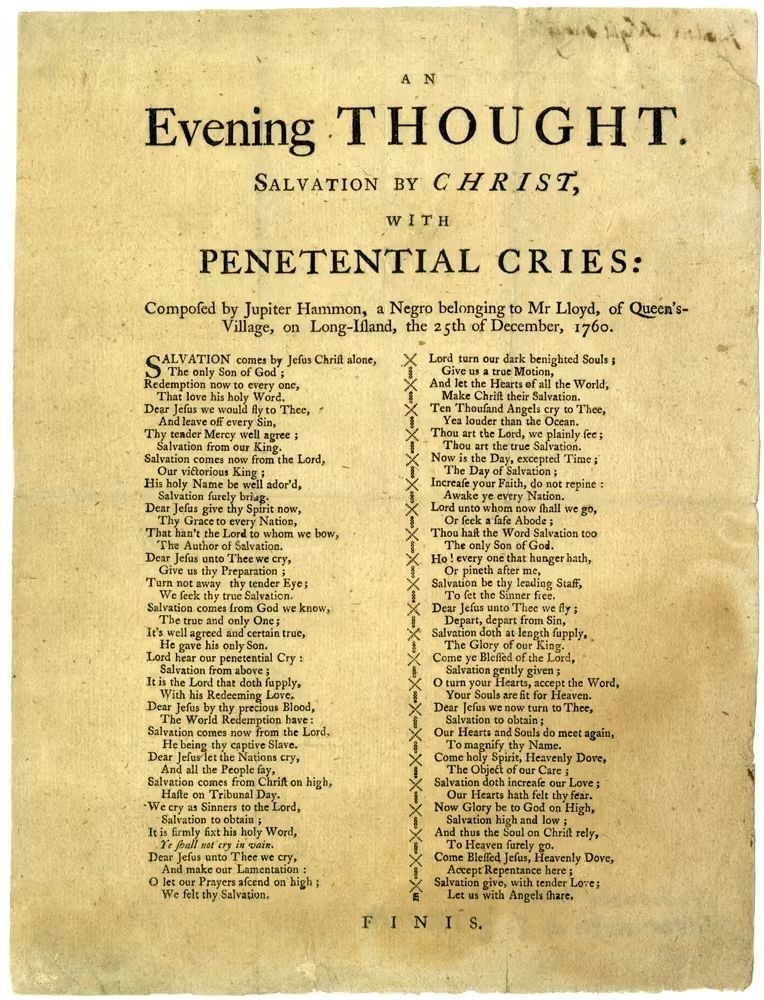
An image of an early published version of Hammon’s first published work on a old, yellowed piece of paper. You can read the full text here. Image Source: NY Historical Society
Together, they opened doors that generations of writers would walk through, like Paul Laurence Dunbar, who became one of the first widely recognized Black poets in American literature. Langston Hughes emerged as a leading voice of the Harlem Renaissance in the 1920s, writing poems that captured everyday Black life with clarity and rhythm. Gwendolyn Brooks made history in 1950 when she became the first Black poet to win the Pulitzer Prize for Poetry. Maya Angelou, known for both her poetry and her memoirs, became one of the most recognized literary figures of the 20th century. Robert Hayden became the first Black Poet Laureate of the United States. Audre Lorde wrote poems that drew from her experiences as a Black woman, exploring identity, feminism, and civil rights. More recently, Amanda Gorman captivated the world with her original poem at the 2021 presidential inauguration, becoming the youngest inaugural poet in American history.
The idea for Black Poetry Day started with Stanley A. Ransom, a white librarian and folk musician who dedicated his career to learning about Jupiter Hammon. In 2020, he published "America's First Black Poet: Jupiter Hammon of Long Island," which includes Hammon's original works along with illustrative details about his life. As early as 1970, Ransom proposed that October 17th be celebrated as Black Poetry Day "to recognize the contributions of African American poets to American life and culture and to honor Jupiter Hammon, first Black in America to publish his own verse." The library where he worked celebrated the date from the start, but Black Poetry Day grew in popularity when SUNY Plattsburgh began hosting the annual event in 1984. Today, it is not an official federal holiday, but it is observed in classrooms and libraries across the country and recognized as a state observance in Oregon.

Listen to poet Terrance Hayes read 'The black poet would love to say his century began,' a poem which, in part, warns about tokenizing the diversity of thought and expression from Black writers. This is the first poem from his book “American Sonnets for my Past and Future Assassin.” Here is a review that helps contextualize its meaning.
Jupiter Hammon never saw freedom. He died in slavery and was buried in an unmarked grave on the Lloyd estate. But the words he put to paper centuries ago are still with us, and the day set aside in his honor keeps his work alive — along with the work of so many others. Each year’s commemoration is an invitation to reflect on how poetry has been used as a vehicle for Black people to express sorrow and joy, to celebrate and challenge, to tell intimate confessions or make broad statements against systemic inequities.
Black Poetry Day isn't only about looking backward, though. It's also a chance to discover poets who are writing right now, telling their own stories in their own voices. That matters because Black writers remain underrepresented in publishing. Approximately 5 to 7 percent of published authors in the United States are Black, and they make up less than 2 percent of the New York Times bestseller list. Only about 12 percent of children's books feature Black characters or are written by Black creators. Black Poetry Day is an invitation to read widely, seek out writers you haven't heard of, and support the voices that don't always get the attention they deserve.
Reflection Questions
Today, schools and libraries are removing books by diverse authors from their shelves through book bans. Knowing that laws once existed specifically to stop Black people from learning to read and write at all, what connections do you see between the past and the present? What do you think is at stake when certain voices are removed from the places where people go to learn?Hammon's poems looked like religious writing on the surface, but scholars believe they contained hidden messages about slavery and white supremacy meant only for certain readers. Why do you think he might have written that way, and what does it tell you about how people find ways to communicate when speaking freely isn't safe?Black writers make up only 5 to 7 percent of published authors in the United States today, more than 260 years after Hammon published his first poem. What does that gap tell you about systemic inequity?
Learn More
Read these twelve poems for Black History Month curated by poets.org.The American Writers Museum has a ton of virtual exhibitions and reading lists for all ages to celebrate Black Poetry Day. Check it out!Follow the hashtag #BlackPoetryDay on a social media platform of your choice to read and listen to poetry from a diverse range of writers and creators.Watch this short video on the life and legacy of Phillis Wheatley.Explore this list of Black poetry anthologies–books that curate a collection of multiple poems–provided by the Oakland Public Library.Jupiter Hammon was inspired by Phillis Wheatley and wrote her a letter. You can read it here.
Never miss a story
Get stories of overlooked and untold Black history in your inbox, free every week.