Emma Chambers Maitland
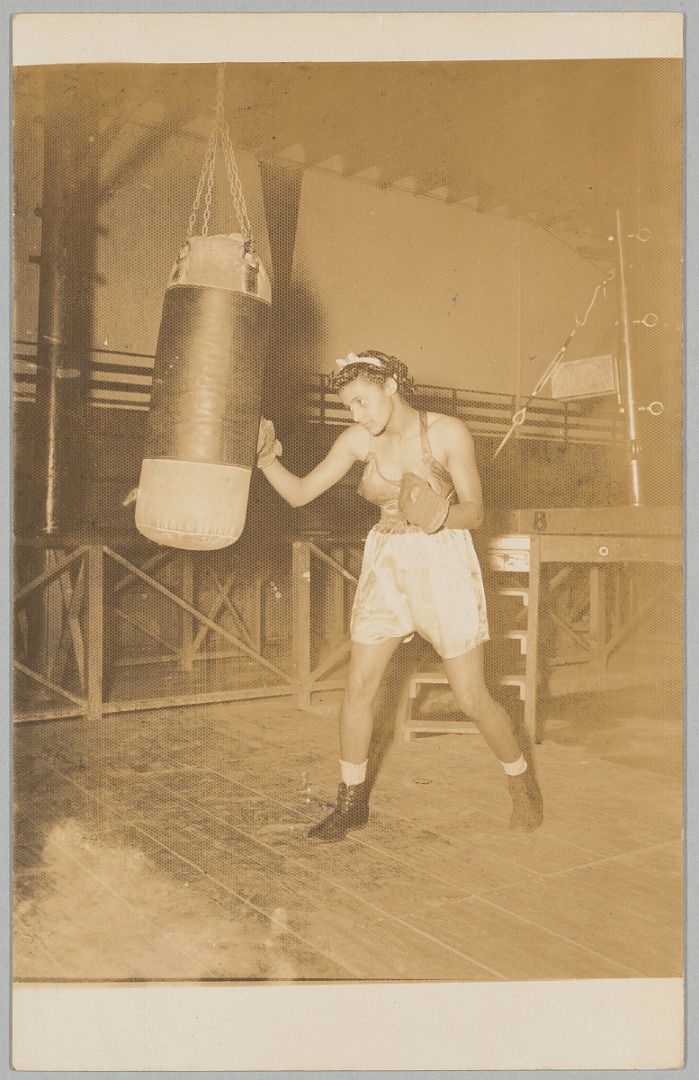
Emma Maitland
As a teacher, dancer, world lightweight female boxing champion, Broadway performer, and nurse, Emma Chambers Maitland forged her own extraordinary path during a time when options for Black women were severely limited.
Maitland was born as Jane Chambers in Virginia in 1893. Her parents were sharecroppers, and she lived with her seven brothers on a tobacco farm. But she refused this path as her own, and was determined to seek a new life. She once boldly declared she was "through killing tobacco worms."
When she was a teenager, she secured an education at a convent school in Rock Castle, Virginia, after a local priest recognized her potential. Despite her father's discouragement, she moved there and studied to become a teacher. She taught for three years, until she was ready to make the move to Washington D.C., changing her name to Emma and leaving her old life behind.
She met Clarence Maitland, a Howard University medical student, and they quickly fell in love. They got married and had their daughter in 1917. But Clarence passed from tuberculosis just months later. "Within one year, I was a fiancée, a wife, a mother, and a widow," Emma wrote in her journal.
Faced with supporting herself and her child, Maitland made the bold decision to move to Paris, following many African Americans seeking refuge from racism in the U.S. She worked initially as an artistic model and dancer at several venues, including the famous Moulin Rouge. But it was her boxing career that would keep her in the spotlight.
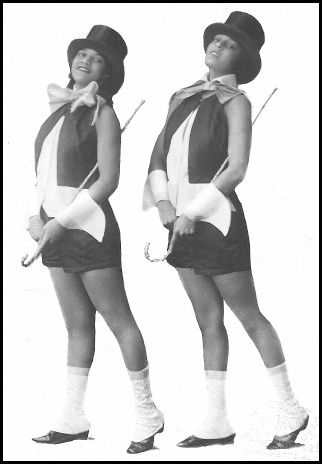
A black and white photograph of Emma Chambers Maitland posing with Aurelia Wheeldin as dancers for the performance “Tea For Two Girls.” Photo Credit: Cathy Van Ingen
Initially, the boxing act Maitland developed with American performer Aurelia Wheedlin was going to be simply a stage show. But it evolved into a serious athletic career. Maitland began training alongside boxer Jack Taylor, and toured all of Europe, becoming one of the world's lightweight female boxing champions during that time. Her boxing performances extended to Canada, Cuba, and Mexico—remarkable achievements for a Black woman in the early 20th century.
When she returned to the United States in 1926, Maitland settled in New York during the Harlem Renaissance. She continued boxing while expanding into theater, appearing in groundbreaking productions including "Messin' Around" (1929), "Change Your Luck" (1930), and "Fast and Furious" (1931). She performed in "Shuffle Along," the first Broadway show entirely created and performed by African Americans, and at the legendary Apollo Theatre. She worked as a bodyguard for a wealthy woman, taught dance and gymnastics, and even studied to become a nurse.
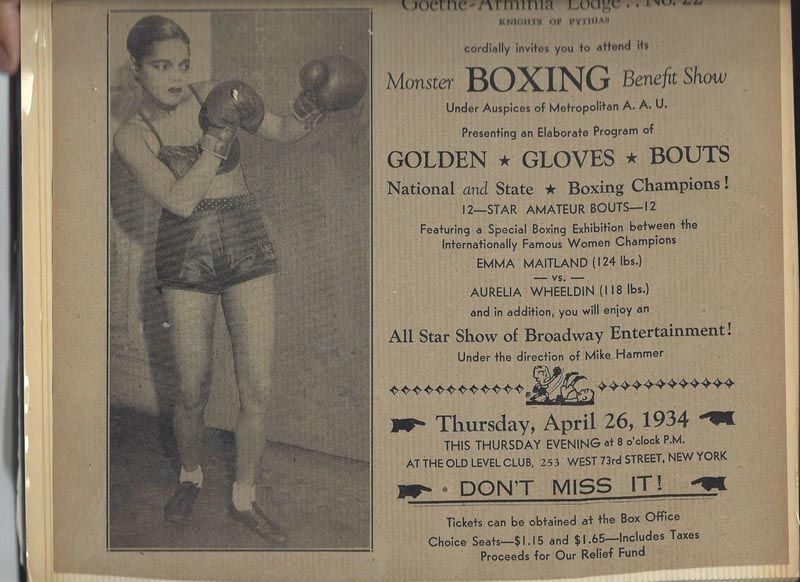
A photograph of a newspaper clipping promoting an upcoming boxing match between Maitland, depicted in a black and white photograph in workout attire and boxing gloves, hands lifted to frame her face, and Aurelia Wheeldin, April 26, 1934, NY Golden Gloves. Photo Source: Vineyard Gazette
Maitland retired to Martha's Vineyard, where she lived until her death in March 1975 at the age of 82. She had donated her papers to the Schomburg Collection at the New York Public Library in 1943, which archived much of her life. Her Oak Bluffs home became the 26th site on the African American Heritage Trail of Martha's Vineyard, and the Vineyard museum featured her life in a 2020 exhibit.
As Heritage Trail co-founder Elaine Cawley Weintraub stated, Maitland "took life by the throat and didn't accept limitations, whether gender, ethnicity, or the racism of America in that time period." Her legacy serves as a blueprint for the possibilities we can claim for ourselves when we refuse to be defined by others and instead boldly create our own extraordinary path.
Reflection Questions
Maitland deliberately changed her name and left her life in Virginia behind to pursue opportunities. How does her story reflect the complex relationship between personal identity, geographic mobility, and freedom for Black Americans during the early 1900s?In what ways do you believe Maitland was supported by her community? How many they have shaped a role in the paths she chose?
Learn More
Read more about Maitland’s life in Martha’s Vineyard in their local publication
Get a boxing demo in the spirit of Emma’s work in this YouTube video
Never miss a story
Get stories of overlooked and untold Black history in your inbox, free every week.