George Washington Carver Day
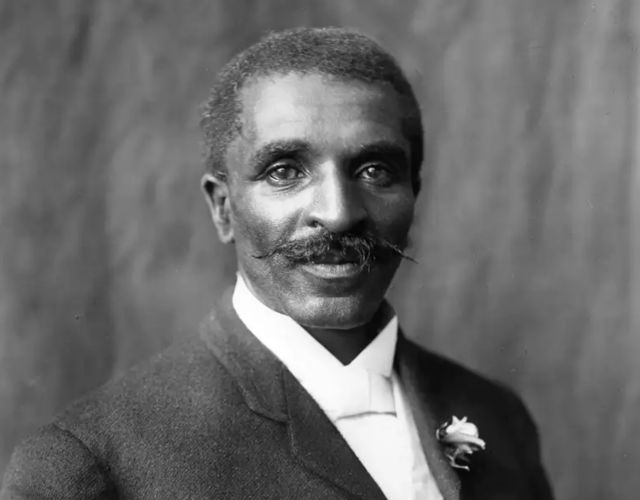
George Washington Carver Day honors the life and legacy of a scientist born into slavery who revolutionized Southern agriculture. Carver was born enslaved around 1864 on a plantation near Diamond, Missouri (the exact date remains uncertain). Before George reached his first birthday, slave raiders kidnapped him, his mother, and his sister from the Carver farm. The three were taken to Arkansas and resold in Kentucky. The slaveowner Moses Carver hired a neighbor to find them, but could only find George. His mother and sister were never seen again.
Moses and his wife, Susan, raised George and his brother James as their own children, teaching both boys to read and write. James helped Moses with fieldwork, but George's health was weak, making physical farm labor impossible. Instead, Susan taught him cooking, mending, embroidery, laundering, gardening, and how to make simple herbal medicines.
As a child, George Washington Carver developed an intense fascination with plants. He began experimenting with natural pesticides, fungicides, and soil treatments to support the work in the fields. Local farmers began calling him "the plant doctor" because of his uncanny ability to diagnose and fix problems in their gardens, fields, and orchards. This early passion for understanding nature shaped his entire life's work.
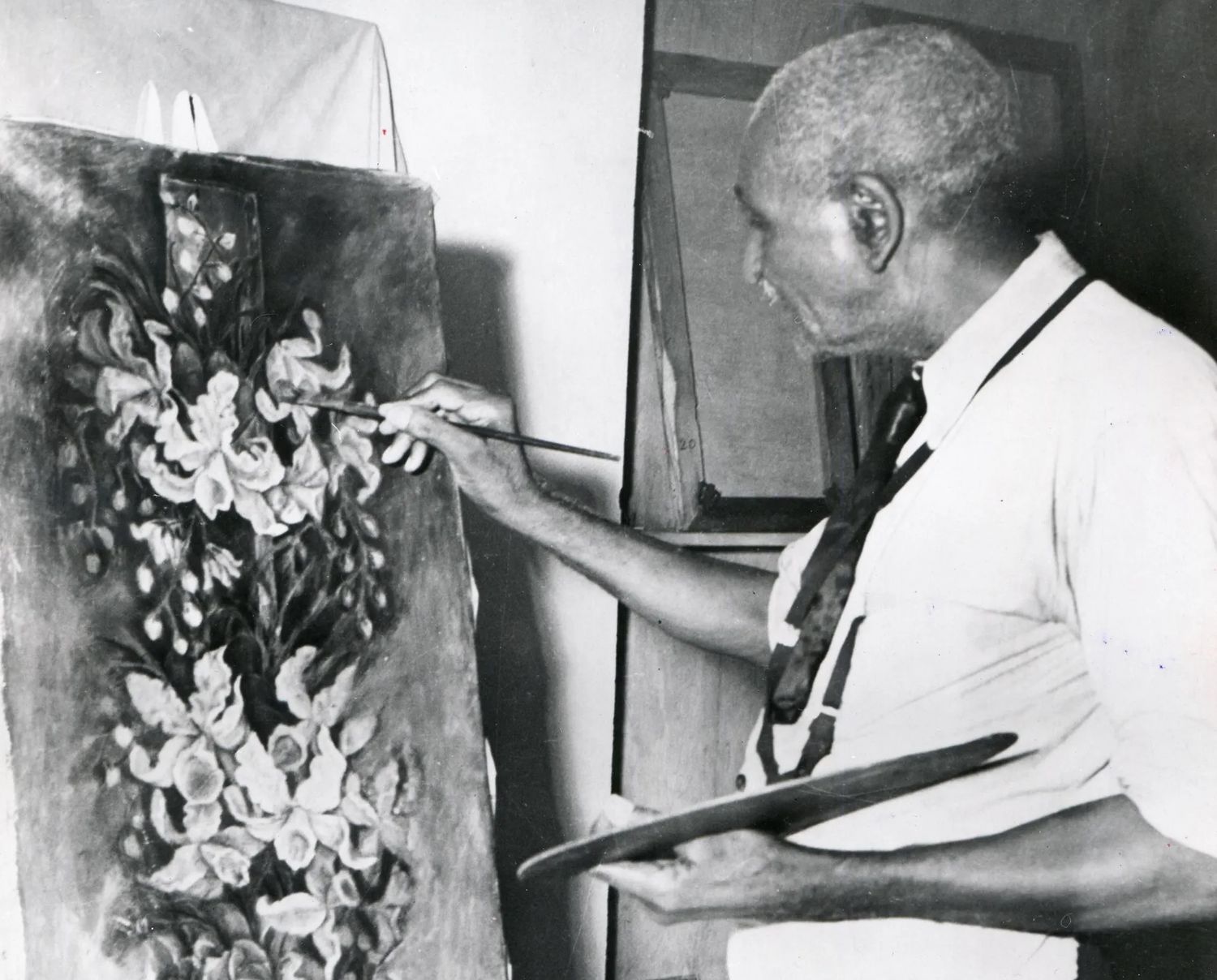
A black and white photo of Carver working on one of his last paintings, entitled "The Yucca.” Photo Source: Photoquest/Getty Images
At age eleven, Carver left the farm to attend an all-Black school in nearby Neosho, Missouri. He lived with Andrew and Mariah Watkins, a childless Black couple who provided shelter in exchange for household help. Mariah, a midwife and nurse, shared her extensive knowledge of medicinal herbs along with her deep religious faith. After about two years, disappointed with the quality of education at the Neosho school, Carver decided to move to Kansas.
For roughly the next decade, Carver traveled from one Midwestern town to another. Along the way, he picked up work helping farmers tend to their crops. He graduated from Minneapolis High School in Minneapolis, Kansas, in 1880 and applied to Highland College. He was initially accepted but later rejected when administrators discovered he was Black.
In the late 1880s, Carver was inspired to try higher education again. He enrolled at Simpson College in Iowa, a Methodist institution that admitted all qualified applicants regardless of race. He was their first Black student and studied art and piano, hoping to become a teacher. His professor, Etta Budd, was worried that a Black man could earn a living as an artist. Instead, she encouraged him to study botany at Iowa State Agricultural School.
In 1894, Carver became the first African American to earn a Bachelor of Science degree from Iowa State. His research on fungal infections in soybean plants was well-received and earned him an invitation to attend graduate school. He worked with renowned mycologist L.H. Pammel, refining his expertise in identifying and treating plant diseases.
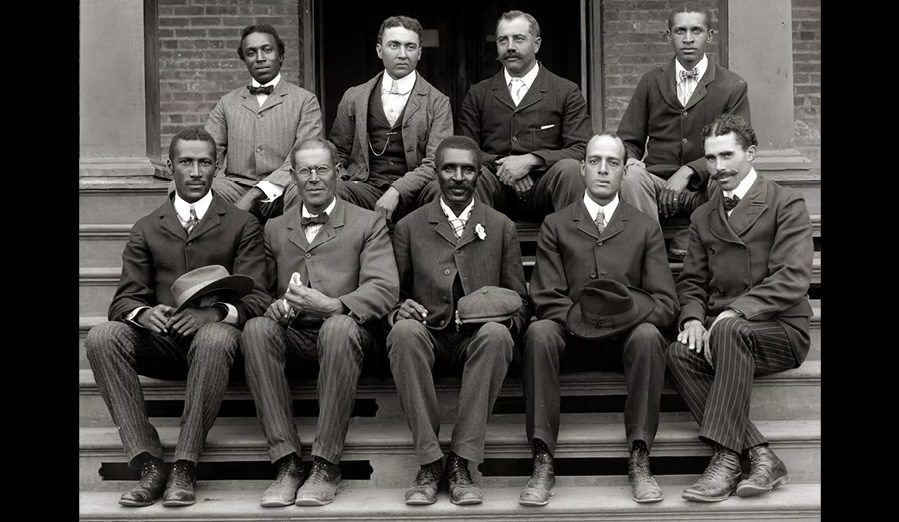
Carver (front, center) alongside other professors at Tuskegee Institute, 1902. Photo Source: Smithsonian Institute
After earning his master's degree in agriculture in 1896, Carver was in high demand and had several job offers to choose from. The most compelling came from Booker T. Washington at Tuskegee Institute in Alabama. Washington was eager to build an agricultural school and wanted Carver to run it. Tuskegee was dedicated to having an all-Black faculty for its Black students, and to Washington, there wasn't anyone more suited for the role. Carver accepted, and was so inspired by Washington's dedication that he added Washington's last name to his own, becoming George Washington Carver.
At Tuskegee, Carver faced enormous challenges. He had no proper classrooms and limited supplies. He would scrounge through junk heaps for bottles and equipment to build a makeshift laboratory. But he threw himself into the work and built curriculum to teach students how to optimize Southern farmland. He taught crop rotation and how to make and use organic fertilizers. He also popularized the practice of planting soil-restoring crops like peanuts, sweet potatoes, black-eyed peas, and soybeans to offset the nutrients depleted by cotton, the dominant crop in the South at the time.
As farmers followed suit, they found themselves with surpluses of peanuts and sweet potatoes. Carver developed hundreds of uses for these crops. He developed methods to turn sweet potatoes into flour, vinegar, ink, dyes, and paints. And, famously, he found over 325 different products from peanuts, including milk, cooking oil, paper, soap, and wood stains (but not peanut butter, despite popular belief!). In 1921, he testified before the U.S. House Ways and Means Committee in support of a protective tariff against cheap imported peanuts from China. His testimony, which received a standing ovation, convinced the committee to pass the Fordney-McCumber Tariff of 1922. He was one of the first Black people to testify as a subject matter expert.
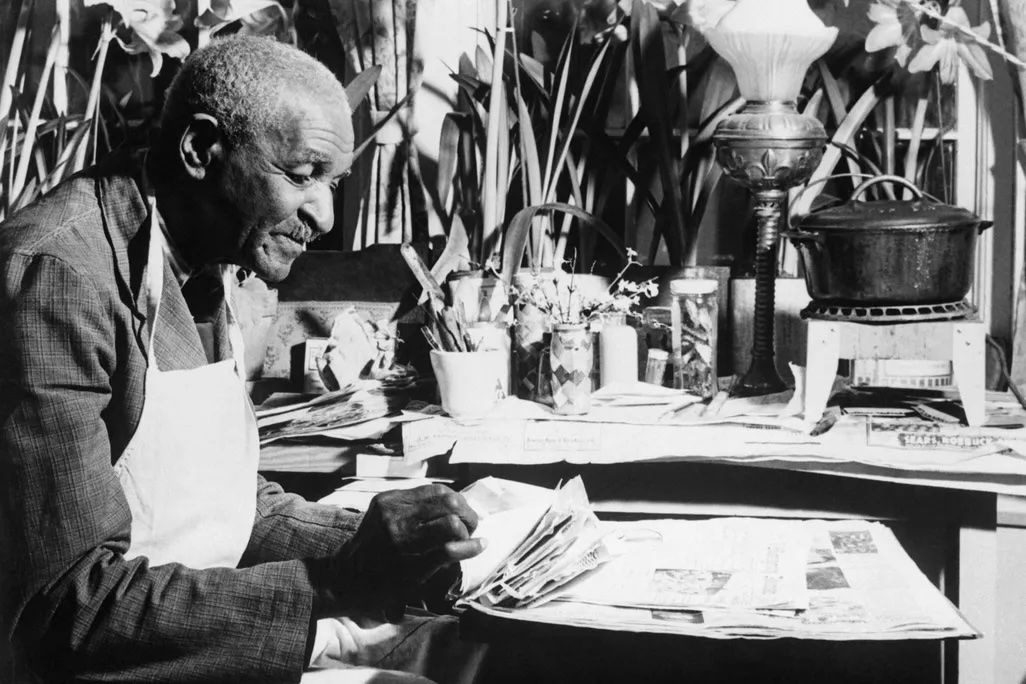
A black and white photo of Carver, taken in roughly 1940, leafing through papers at his desk, which is full of flowers and cuttings. Photo Source: Bettmann
Carver's fame grew throughout the 1920s and 1930s. He gave lectures to packed audiences across the country about his work. He also kept his passion for music and the arts alive by performing piano concerts for Tuskegee fundraising events and exhibiting his artwork on campus. Despite enduring racial discrimination throughout his life, Carver rarely spoke about race publicly, preferring to focus on his work and his faith.
In his final years, Carver was diagnosed with pernicious anemia. He created the George Washington Carver Museum and Foundation at Tuskegee and gifted it his entire life savings — equivalent to nearly $1 million today. He passed away on January 5, 1943, at approximately age seventy-seven. That same year, Congress designated his birthplace as a national monument — the first ever honoring a Black American. In 1945, Congress designated January 5 as George Washington Carver Day. In 2022, leaders in Iowa — the state where Carver first attended college — designated February 1 as George Washington Carver Day in the state as a way to honor Black History Month and ensure kids would be in school so his life and legacy would be present in classrooms, giving his teaching a way to continue long after his death.
Reflection Questions
Carver's early mentors played a significant role in shaping his path. What does that say about the importance of access to mentorship and education?Carver's work with peanuts and sweet potatoes was a direct response to the economic devastation that sharecropping and single-crop farming had caused in the post-Reconstruction South. How does understanding that context change the way you think about his research and its impact?
Learn More
Watch An Uncommon Life, a documentary available on YouTube on the life and legacy of George Washington Carver.Read more about Carver’s artistic practice.George Washington Carver and Henry Ford formed a close friendship in the late 1930s. Learn more about his contributions to the automotive industry. Learn more about sharecropping in the South during Carver’s life by reading this short article or watching this documentary.
Never miss a story
Get stories of overlooked and untold Black history in your inbox, free every week.