Black Masking Indians
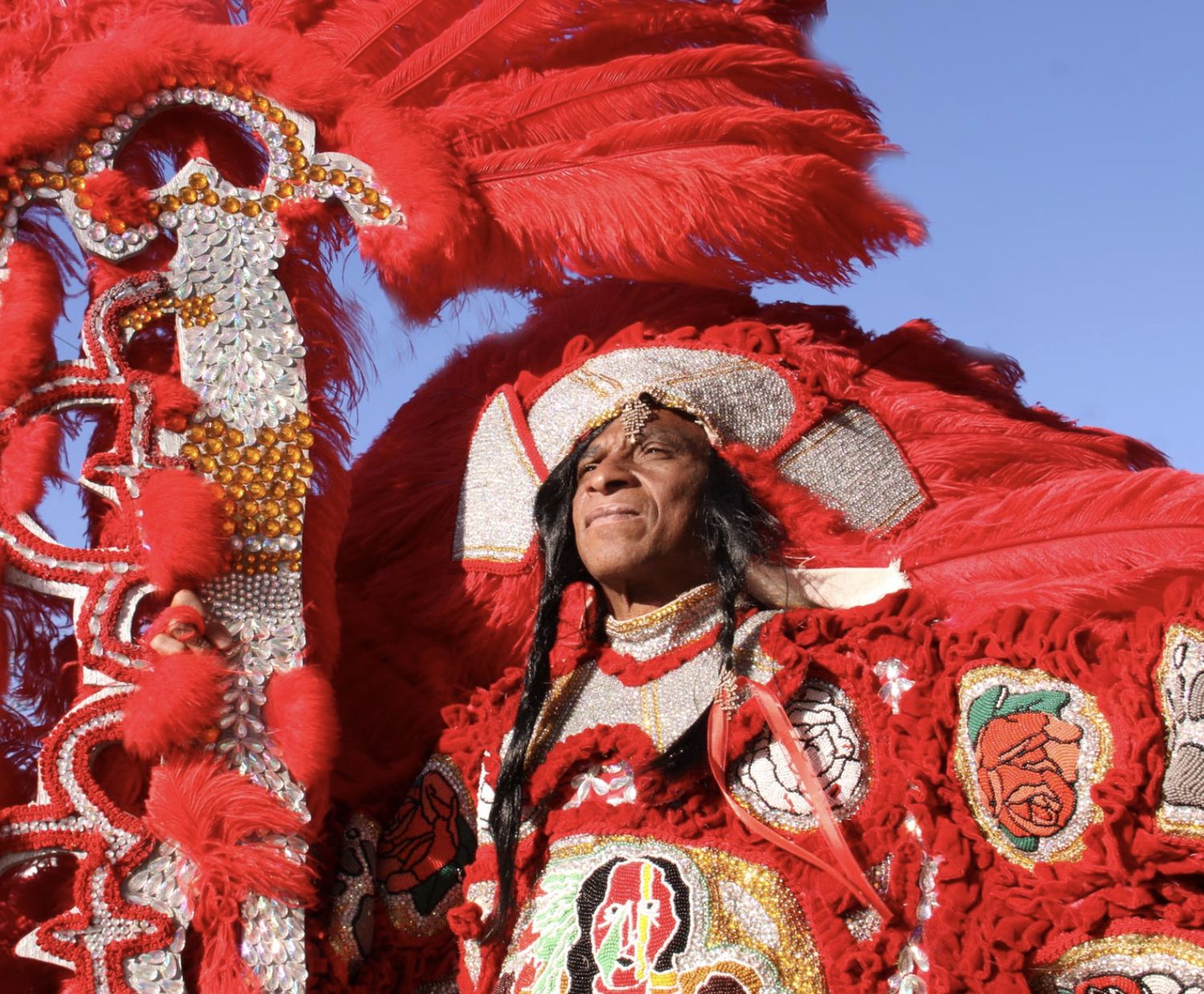
Most people think of Mardi Gras as beads, floats, and crowds on Bourbon Street. But the deeper story of how Black communities shaped this celebration — and built their own when they were locked out — is one worth knowing.
These traditions were brought to present-day New Orleans by French settlers on March 3, 1699. When they arrived, they named their landing spot Point du Mardi Gras and celebrated each year with street parties, masked balls, and fancy dinners. When Spanish colonizers took control of New Orleans in the mid-1700s, they banned these celebrations. The parties didn't return until Louisiana became a state in 1812.
By 1827, residents dressed in colorful costumes and danced through the streets, copying what they had seen in Paris. Ten years later, the first official Mardi Gras parade happened. In 1857, a secret group of wealthy white businessmen called the Mistick Krewe of Comus organized a parade with torches, marching bands, and decorated floats — setting the pattern for celebrations to come.
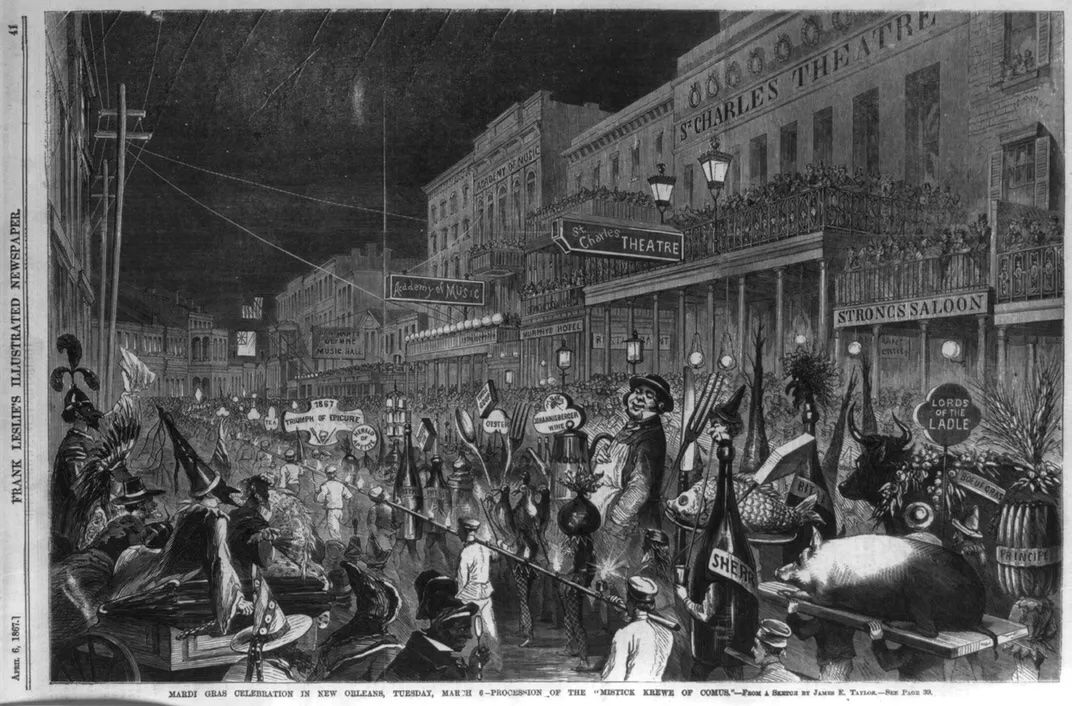
A black and white drawing of an 1867 Mardi Gras celebration featuring the Mistick Krewe of Comus. Image Source: Public domain via Wikimedia Commons
Black people in New Orleans, however, were not allowed to join. The law banned Black people from gathering in public spaces, so these nineteenth-century parades were whites-only affairs. They often celebrated southern white power and protested the rights Black Americans had gained after the Civil War through the Fourteenth and Fifteenth Amendments.
So Black communities built their own Mardi Gras. They took over backstreets — turning Claiborne and Jackson into their own Mardi Gras corridors long before the city officially recognized them. Every neighborhood developed its own ways of celebrating, and what grew out of those streets was both a party and an act of resistance.
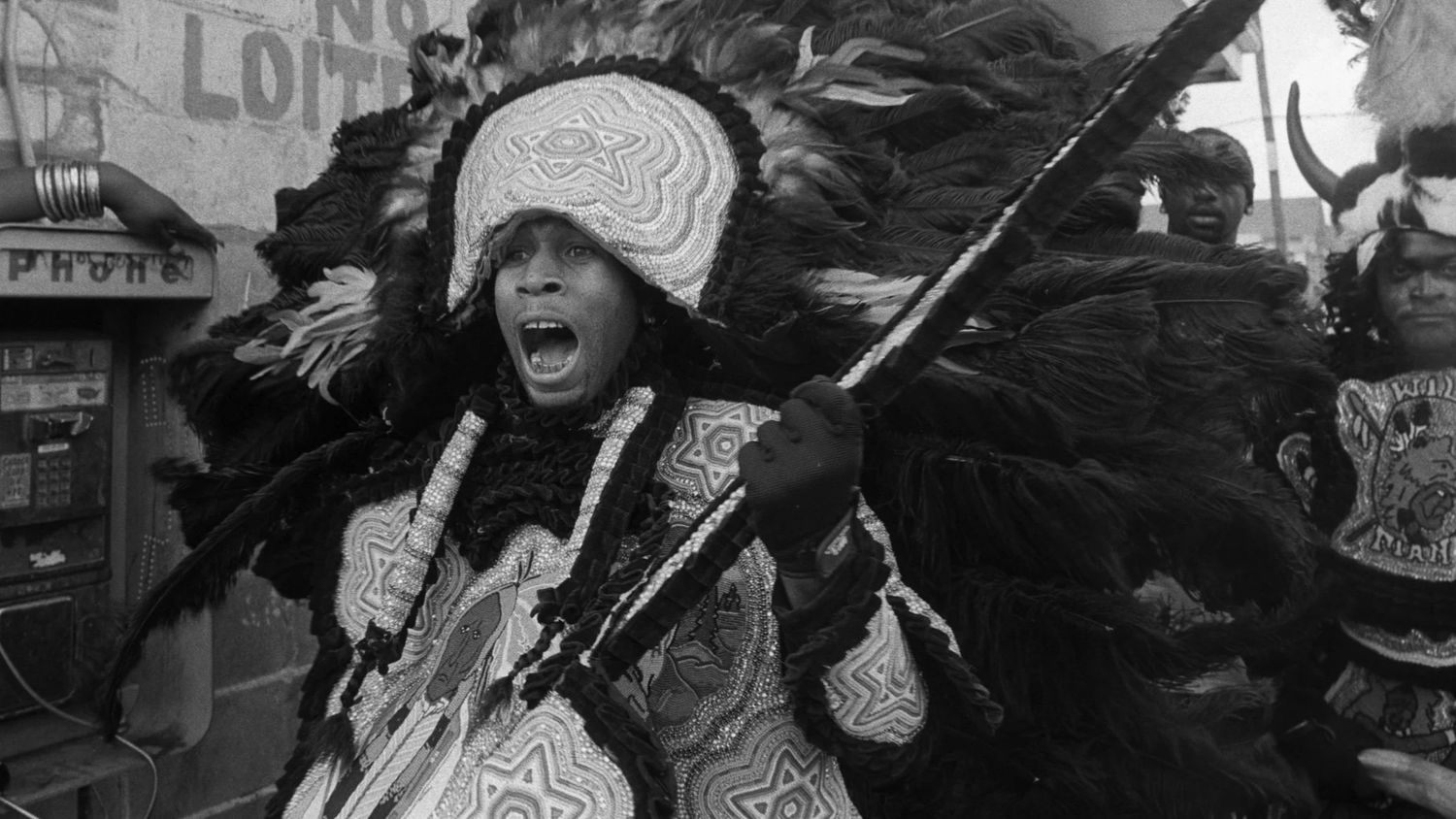
A black and white photograph of Demond Melancon, the Big Chief of the Young Seminole Hunters tribe, mouth open in chant or song while walking during a parade. According to his website: “Big Chief Demond Melancon’s Suits are technically extraordinary due to two primary factors: the monumental size of his main aprons, worn from the waist to the ankles, and his use of exceptionally small glass seed beads. His fully beaded aprons often exceed 50 inches in width and are constructed using size 11/0 beads, which measure just 2.1 mm, smaller than what is typically used by other Black Maskers in New Orleans. As a result of this combination of scale and precision, Melancon’s Suits require more than 4,000 hours of hand sewing over one million beads to complete.”
One of the most powerful traditions to emerge was the Mardi Gras Indians, also called Black Masking Indians. Their roots run in two directions at once. When enslaved people escaped plantations, they sometimes found refuge with Native communities in Louisiana, building relationships through trade and mutual defense. At the same time, masking itself — donning elaborate costumes to embody spirits or ancestors — was a practice with deep roots in West African and Afro-Caribbean cultures, carried to America through enslavement. These two traditions met in New Orleans and wove together into something new.
Each neighborhood has its own Indian tribe, and members spend most of the year hand-sewing the intricate suits and headdresses they'll wear each February. Each suit tells stories: Scenes from Congo Square. The aftermath of Hurricane Katrina. Ancestors who fought for their freedom. The groups carry their own call-and-response chants, drumming, and dances through the streets each year. And their community doesn't stop when the parade ends. These tribes look after each other year-round — helping families navigate schools and courts, checking on children, and keeping Black culture rooted in their neighborhoods.
In 1901, a group of Black men formed a Benevolent Aid Society, a mutual aid network providing resources where state and federal support failed. By 1909, they had become the Zulu Social Aid and Pleasure Club and made their first Mardi Gras parade appearance. Members wore grass skirts, bushy wigs, and blackface makeup — a deliberate provocation designed to mock the racist caricatures of white minstrel shows while simultaneously celebrating dark skin. In a New Orleans where colorism divided Black communities through "brown paper bag tests" and other practices that favored lighter-skinned Creoles, Zulu pushed back by embracing Blackness openly.
Watch this short documentary on the Black Masking Indians featuring Shaka Zulu, Black Masking craftsman, stilt dancer, musician, and 2022 National Endowment for the Arts National Heritage Fellow.
The official desegregation of Mardi Gras krewes didn't happen until 1992, when long-time civil rights advocate Dorothy Mae Taylor fought for the city to pass legislation requiring it. Ironically, Zulu had already integrated white members in 1973 — nineteen years ahead of the law. Even after official desegregation, racism didn't disappear. In 2018, vendors sold beads featuring the removed statue of Confederate General Robert E. Lee inscribed with "Forever Lee Circle." Confederate flags appeared at parade route stands in towns like Slidell, named after Confederate ambassador John Slidell. Despite these pressures, Black Mardi Gras traditions continue.
If you want to see the Mardi Gras Indians in person, you have more opportunities than just Fat Tuesday. Tribes gather several times a year for what are known as Super Sundays — celebratory processions held in the spring across three different parts of the city. Uptown Super Sunday typically falls on the third Sunday of March, closest to St. Joseph's Day. Downtown tribes gather at Bayou St. John, and the West Bank community holds its own in Algiers. Each Super Sunday has its own date and its own feel, rooted in the neighborhood it comes from. Wherever you choose to celebrate, you’ll be honoring what Black New Orleanians built for themselves when the larger world tried to shut them out–a practice that persists, proudly, year after year.
Reflection Questions
The Mardi Gras Indians spent generations building a rich cultural tradition in spaces the city didn't officially recognize. What traditions or gathering places in your own community serve a similar purpose — and what would be lost if they disappeared?Zulu made a deliberate choice to reclaim racist imagery and flip its meaning. Can you think of other examples where a marginalized community has done something similar? Did it work? Who gets to decide?The article ends with the image of young people running up to chiefs, wanting to carry the tradition forward. What makes a cultural tradition worth preserving — and what responsibility, if any, do outsiders have in protecting traditions that don't belong to them?
Learn More
Explore these vintage photos of Mardi Gras in 1938.Join New Orleans native and musical artist Tank Ball as she meets Masking Indians and explores one of the most sacred rituals in New Orleans.Watch Treme on HBO, which features the Black Masking Indians.Watch scenes of last year's Downtown Super Sunday parade on April 6, 2024.Read Mardi Gras Indians by Nikesha Elise Williams, Jockomo: The Native Roots of Mardi Gras Indians by Shane Lief, and No I Won't Bow Down on That Dirty Ground by Dr. Maurice M. Martine
Never miss a story
Get stories of overlooked and untold Black history in your inbox, free every week.