Marjorie Stewart Joyner
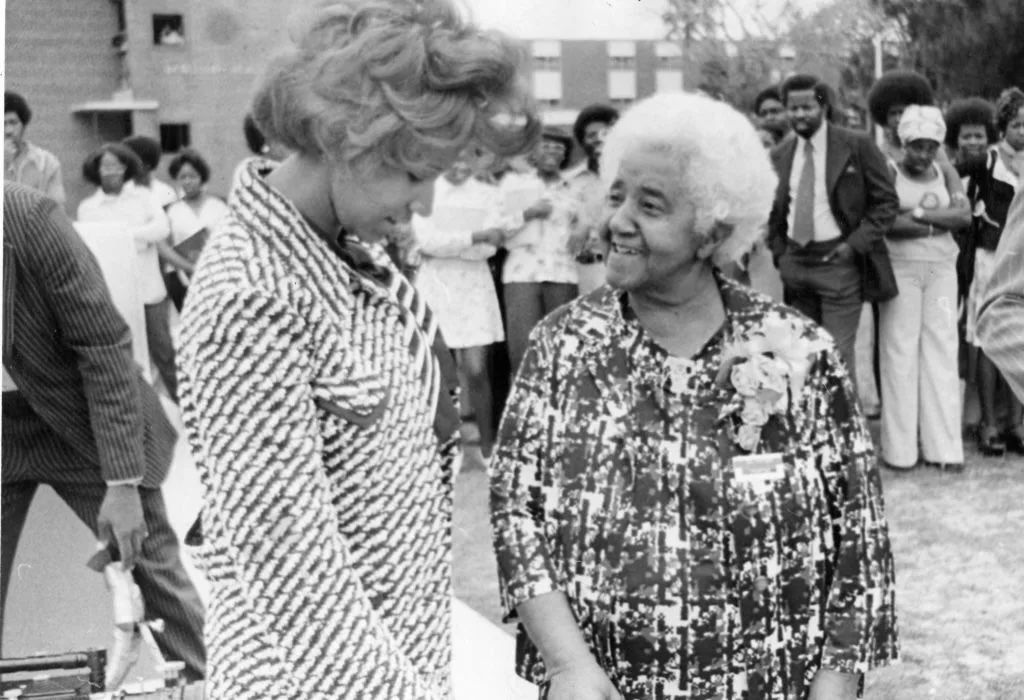
Marjorie Stewart was born on October 24, 1896, in the small mountain town of Monterey, Virginia. She grew up in extreme poverty with twelve siblings, though only three survived to adulthood. When she was eight years old, her family moved to Dayton, Ohio, where her father found work as a teacher. Her parents soon divorced, and young Marjorie lived with different relatives for several years. In 1912, at age sixteen, she moved to Chicago to join her mother.
In Chicago, Marjorie needed to earn money to help support her household. She worked as a waitress and a domestic servant while learning the beauty trade. In 1916, she became the first African American to graduate from the A.B. Molar Beauty School in Chicago. The school only offered a few weeks of classes with little hands-on practice, and all the training focused on styling white women's hair. Joyner opened her own salon in Chicago’s South Side to bring her new skills back to her community, but didn’t know how to work with Black hair. Her mother-in-law encouraged her to attend a lecture by Madam C.J. Walker, a successful businesswoman in the hair care industry. Marjorie paid $17.50 to enroll in Walker's beauty school in Chicago.
Madam Walker must have recognized something special in her ambitious young student. Walker was born into slavery and worked as a washerwoman for years before starting her own hair care company. By the time Marjorie met her, Walker had a successful business that employed thousands of African American women across the country. Within months of meeting, Walker recruited Marjorie to become her national spokesperson and adviser. The two became close friends, and Walker asked Marjorie to act as an adviser for her national network of beauty schools.
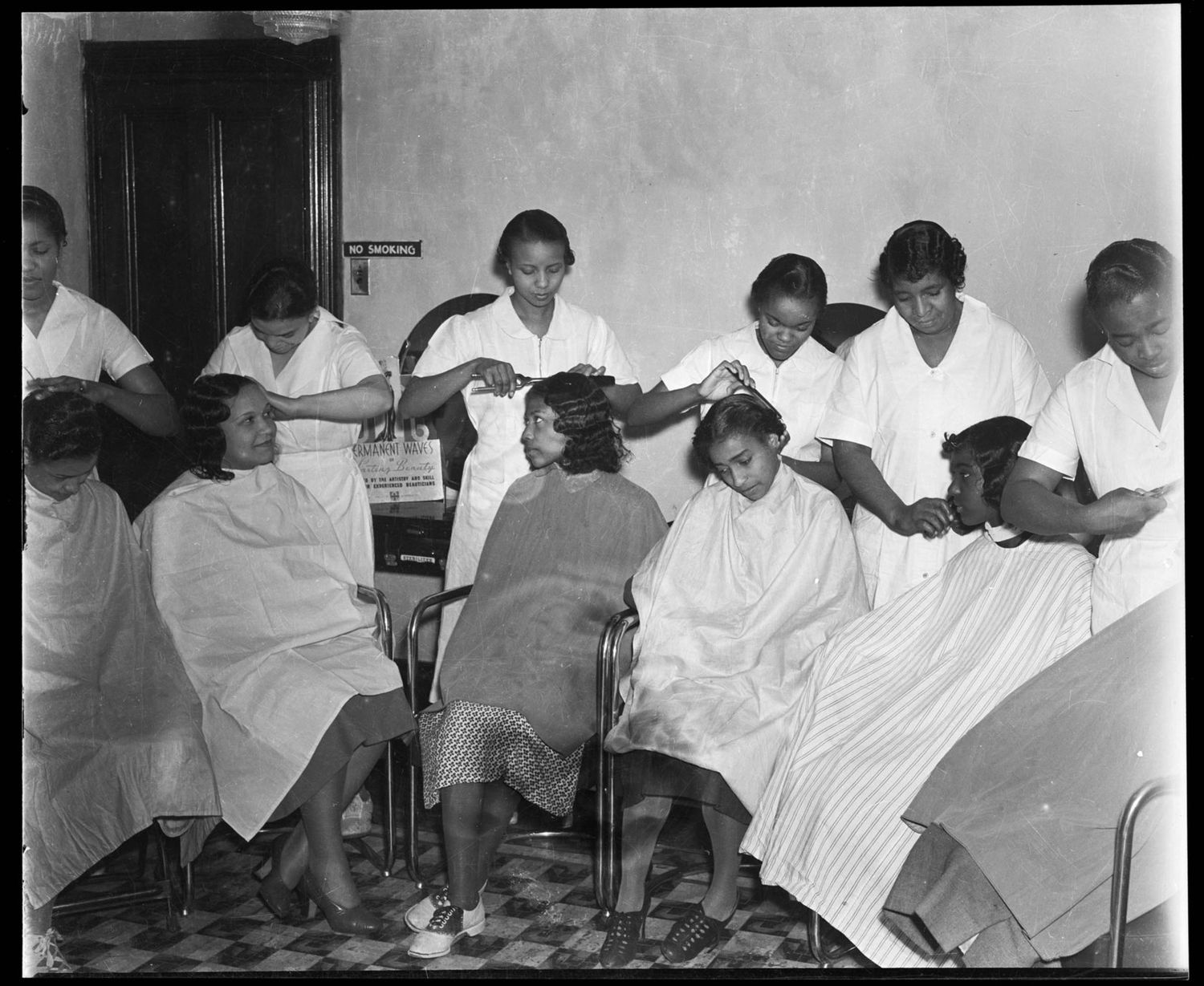
A black and white photograph of six women wearing light colored smocks working on six women’s hair in the Marcel wave style, in a beauty shop with a checkered floor and a sign inscribed “Permanent Waves of Lasting Beauty” and “No Smoking.” Photo taken by Charles “Teenie” Harris and likely in Pittsburgh, PA. Note: it is unclear whether or not these stylists are associated with Madame C.J. Walker’s company.
When Walker died in 1919, Marjorie continued her work with the company. Over the next several decades, she led a network of 200 beauty schools that trained over 15,000 stylists. As she traveled to different schools and taught students in Chicago, she noticed a persistent issue. The popular hairstyle at the time was the Marcel wave, but it took a long time for stylists to do because it required using a curling iron one small section at a time.
One evening while making pot roast for dinner, Marjorie had an idea. She noticed the long, thin rods holding her roast together and heating it from the inside. She thought about how these rods might work for hair styling. What if multiple rods could be applied to someone's hair all at once? It would cut down on styling time and still create a ‘do that would last for days.
Marjorie started experimenting with her pot roast rods and an old hair dryer hood. She fastened sixteen rods to the hood and created a device that could curl multiple sections of hair simultaneously. The machine worked beautifully, and she used it in her salon for a few years before realizing she should protect her invention with a patent.
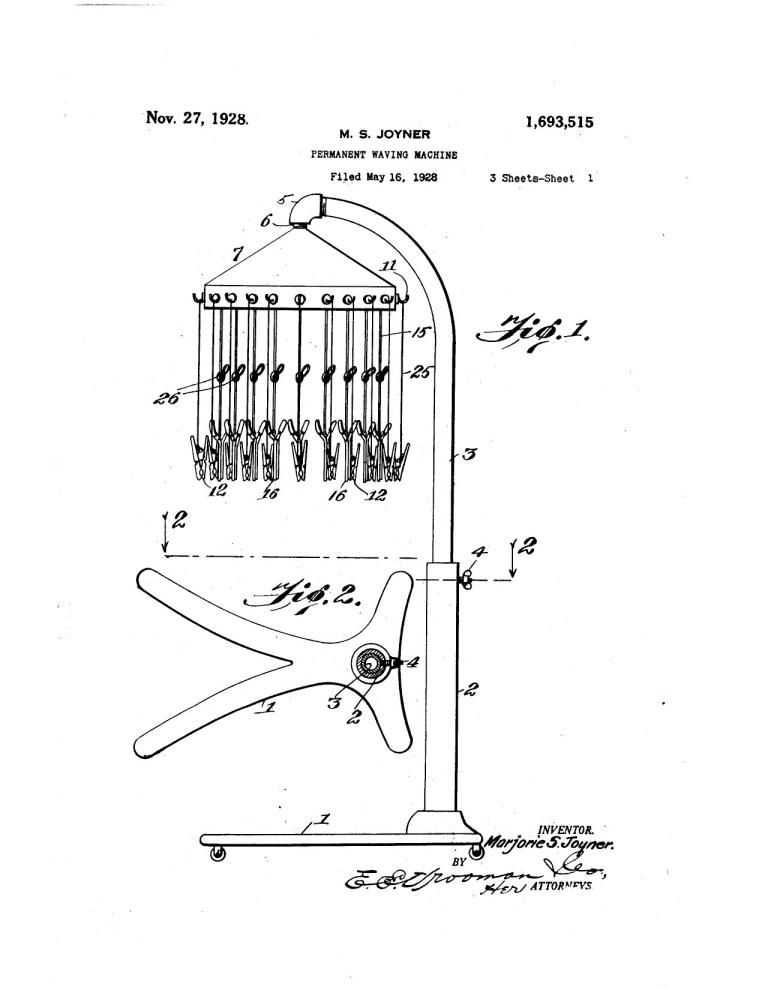
An image of the original patent submitted by Joyner, referred to as “Petition for permanent waving machine patent, May 16, 1928.” Image Source: National Archives at Kansas City, Records of the Patent and Trademark Office
On May 16, 1928, Marjorie filed her patent application, "the construction of a simple and efficient machine that will wave the hair of both white and colored women." She was awarded U.S. Patent No. 1,693,515 later that year, making her one of the first African American women to receive one. In 1929, she also patented a scalp protector device to make the waving process more comfortable for clients. She assigned the rights to both patents to the Madam C.J. Walker Manufacturing Company.
Salons across America quickly adopted her permanent wave machine. Both Black and white clients could now get long-lasting curls or waves in a fraction of the time it used to take. While Marjorie didn't receive substantial financial compensation for her invention, she later said this never bothered her. She was more focused on pushing the industry forward and making her stylists’ job more easeful.
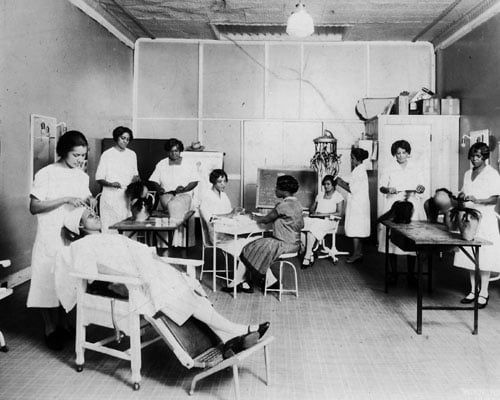
A black and white photograph Joyner (third from right) using her invention on a client while half a dozen other stylists practice on mannequins or people. Photo Source: Library of Congress
Marjorie continued breaking ground throughout her career. In 1924, she helped write the first cosmetology laws for the state of Illinois. In 1935, she became one of the founding members of the National Council of Negro Women, established by her close friend Mary McLeod Bethune. In 1945, she founded the Alpha Chi Pi Omega Sorority and Fraternity for beauty students to help raise professional standards. A year later, she established the United Beauty School Owners and Teachers Association. She became the director of the Chicago Defender’s charities, overseeing food and clothing drives and fundraisers across the city and directing the annual Bud Billiken Parade.
At age seventy-seven, Marjorie decided to go back to school. She graduated with a bachelor's degree in psychology from Bethune-Cookman College in Florida in 1973. She remained active in her community through her church, beauty industry organizations, and charitable work in Chicago. When she passed away on December 27, 1994, at age ninety-eight, Joyner had spent over fifty years with the Walker Company. Her simple but brilliant invention had forever changed the beauty industry, proving that the best ideas can come from the most everyday moments—even while cooking dinner.
Reflection Questions
How did Marjorie Joyner's personal struggles—growing up in poverty, losing siblings, and not finishing high school—shape her later success as an inventor and businesswoman?Marjorie Joyner designed her permanent wave machine to work on "both white and colored women's hair." What does this tell us about her approach to solving problems?
Learn More
Watch this video with archivist Beth Loch that showcases the travel tours Marjorie Stewart Joyner hosted on behalf of United Beauty School Owners and Teachers Association (UBSOTA) and Alpha Chi Pi Omega.Watch Self Made, a miniseries inspired by the life and legacy of Madame C.J. Walker.Read about the enduring legacy of beauty salons throughout history and their role in creating safe and free spaces for Black women. Or, read this article about the specific role they play in the civil rights movement.
Read about historical Black women who have received patents.
Never miss a story
Get stories of overlooked and untold Black history in your inbox, free every week.