Bayard Rustin
Day 7: Bayard Rustin
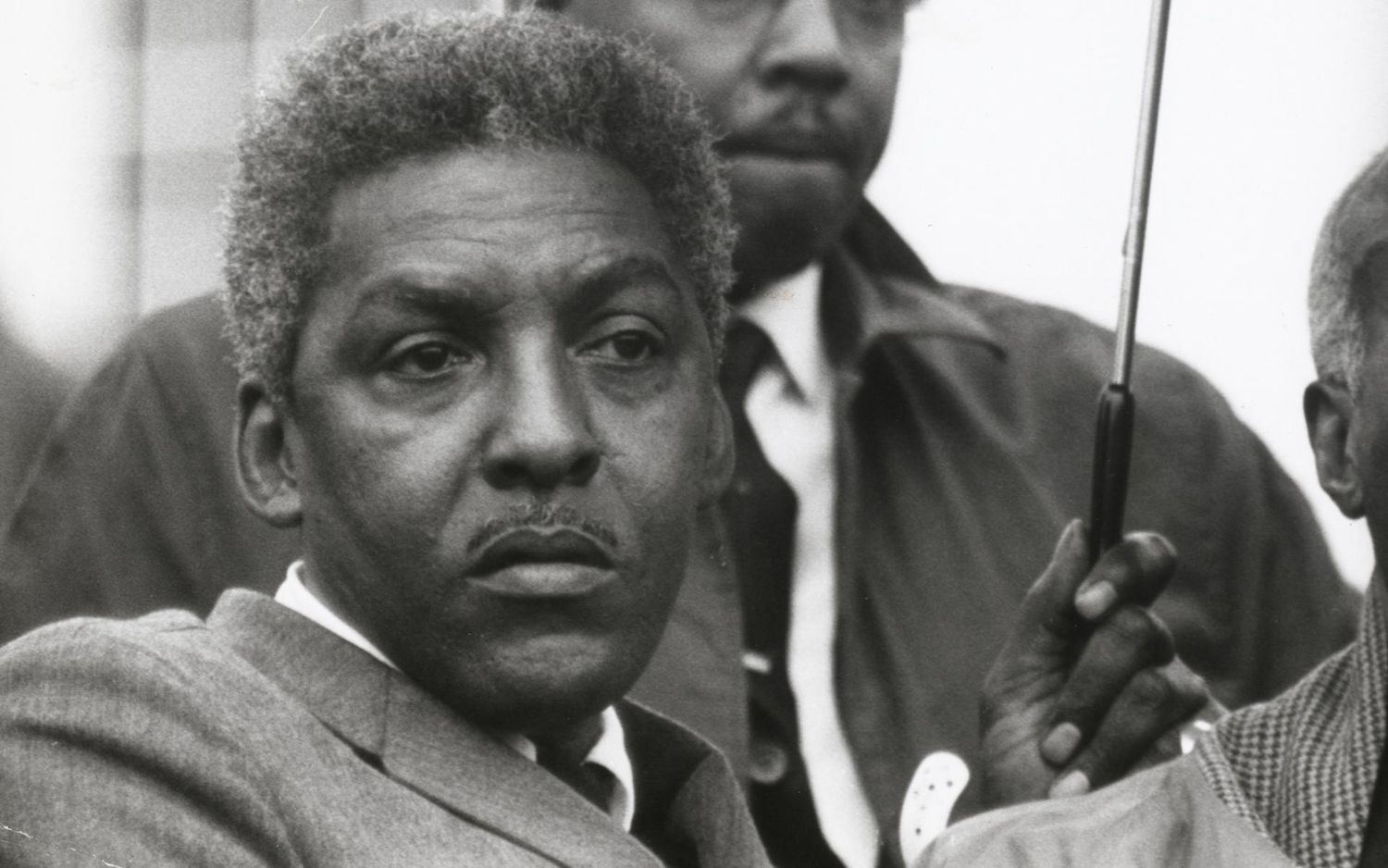
Bayard Rustin (standing next to A. Philip Randolph, not visible in this crop) listening to a speech on the steps of the Alabama State Capitol in Montgomery, Alabama, at the end of the Selma to Montgomery Marches. Photo Source: Steve Schapiro via the National Musuem of African American History and Culture.
Bayard Rustin was a skilled organizer who brought nonviolence to the American civil rights movement, orchestrated the March on Washington, and built bridges between labor unions and civil rights organizations. His life demonstrates how the struggles for racial, economic, and LGBTQ+ justice are interconnected.
On August 28, 1963, as Martin Luther King Jr. delivered his "I Have a Dream" speech to 250,000 people, the man who had made it all possible watched from the shadows. Bayard Rustin had orchestrated every detail of the March on Washington for Jobs and Freedom, down to the number of toilets and sandwiches needed. But many Americans had never heard his name.
Rustin's relative invisibility wasn't an accident. Born in 1912 in West Chester, Pennsylvania, he was raised by his Quaker grandmother, who taught him nonviolent resistance. By the 1940s, he was already an experienced organizer for both labor and civil rights causes. But as an openly gay man in an era of intense homophobia, he was often forced to work behind the scenes.
Yet Rustin's influence was profound. In 1956, he traveled to Montgomery, Alabama, to advise Dr. King during the bus boycott. In King's home, amid death threats and bombings, Rustin taught the young minister about Gandhian nonviolence. He transformed King's understanding of nonviolent resistance from a mere tactic into a comprehensive philosophy of social change.
"We need in every community a group of angelic troublemakers," Rustin declared. His own troublemaking began early. In 1947, he helped organize the first Freedom Ride, the Journey of Reconciliation, to test a Supreme Court decision desegregating interstate travel. The riders faced beatings and arrest. Rustin spent 22 days on a North Carolina chain gang.
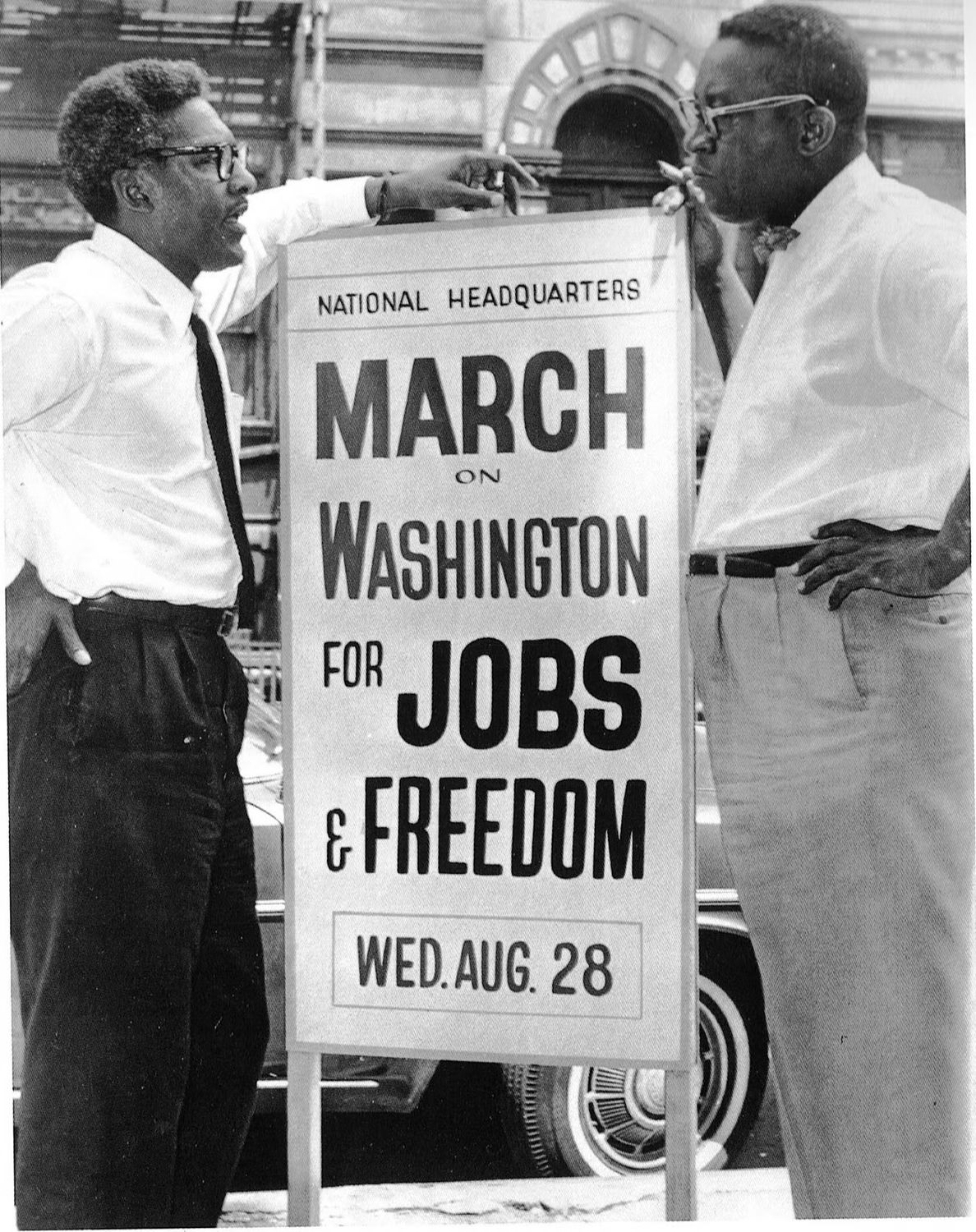
Black and white photograph of Bayard Rustin (left), deputy director, and Cleveland Robinson, chairman of Administrative Committee, standing and leaning on a March on Washington, seeming to be in deep conversation.Photo Source: Walter Naegle, via the National Musuem of African American History and Culture.
But Rustin understood that racial justice required economic justice. He worked closely with A. Philip Randolph (remember him?!), who became his mentor. Together, they planned a 1941 March on Washington to demand defense industry jobs for Black workers. The threat of this march prompted President Roosevelt to issue Executive Order 8802, banning discrimination in defense industries.
Rustin's genius lay in connecting movements. He helped convince labor unions to support civil rights causes, arguing that racism hurt all workers. He worked with Martin Luther King Jr. to create the Southern Christian Leadership Conference (SCLC). He brought together civil rights, labor, and religious leaders to form coalitions.
The 1963 March on Washington represented the pinnacle of this coalition-building. The march's full name – the March on Washington for Jobs and Freedom – reflected Rustin's insistence that economic and civil rights were inseparable. In just eight weeks, he created a sophisticated operation to bring thousands of people to Washington safely and peacefully.
The march's success should have been Rustin's triumph. But when segregationist Senator Strom Thurmond attacked him on the Senate floor for his sexuality and past communist affiliations, some movement leaders wanted to distance themselves. A. Philip Randolph stood firm, declaring that Rustin was absolutely essential to the march's success.
After 1963, Rustin continued fighting for both labor and civil rights. He argued that the movement needed to shift from protest to politics, focusing on economic empowerment and coalition-building. Some criticized this approach as too moderate, but Rustin believed lasting change required building broad alliances.
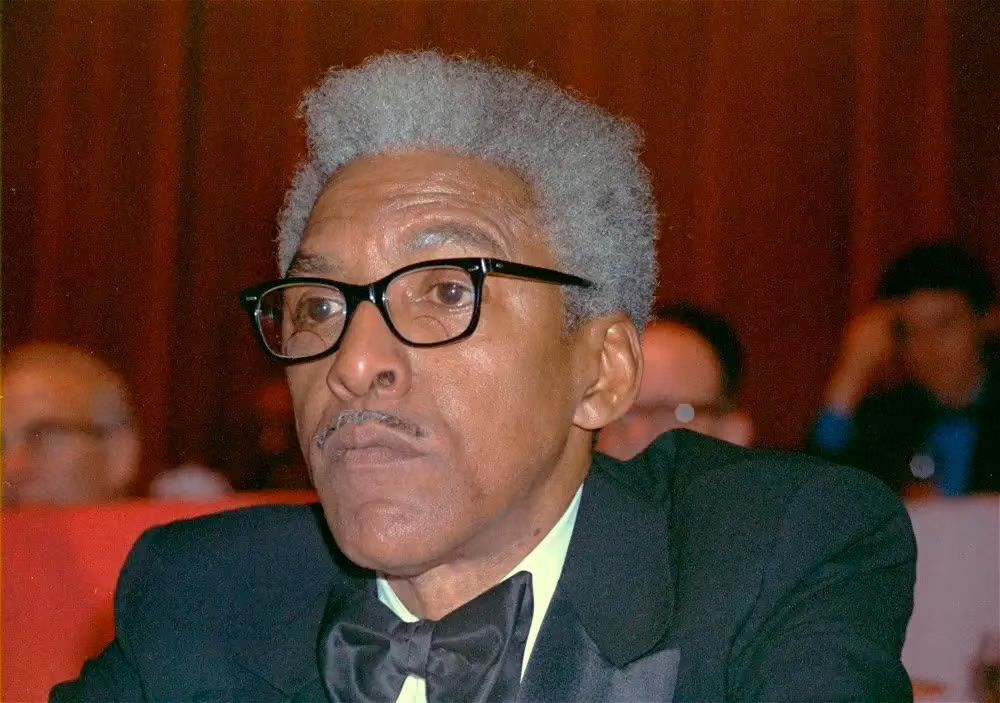
A color photograph of Rustin, depicted later in life, wearing a tuxedo and glasses while sitting in a theatre in New York in 1970. Photo Source: WHYY Media.
In his later years, Rustin became more open about advocating for gay rights, seeing it as an extension of his civil rights work. "When an individual is protesting society's refusal to acknowledge his dignity as a human being," he said, "his very act of protest confers dignity on him."
Rustin's legacy shows how different struggles for justice intersect. His life challenged the movement to be more inclusive, while his organizing skills helped create transformative change. Though he often worked in the background, his impact on American history was profound.
Reflection Questions
Rustin faced discrimination for both his race and his sexuality, yet continued fighting for justice. How can we build movements today that embrace intersectional identities and multiple forms of liberation?
Consider Rustin's emphasis on coalition-building between different movements. What opportunities do you see for building alliances between different justice movements in your community?
Learn More
Watch "Brother Outsider: The Life of Bayard Rustin," the award-winning documentary about his life and work.Watch “Rustin”, the 2023 fictionalized Netflix biopic starring Colman Domingo.Read "Lost Prophet: The Life and Times of Bayard Rustin" by John D'Emilio for a comprehensive biography.Explore the Bayard Rustin Papers at the Library of Congress, which contain his correspondence, writings, and organizing materials.Study the work of the Bayard Rustin Center for Social Justice, which continues his legacy of intersectional organizing.Listen to "Bayard Rustin: Who Is This Man?" an WNYC podcast about his life and influence.
Never miss a story
Get stories of overlooked and untold Black history in your inbox, free every week.