Donald Galloway
Day 20: Donald Galloway
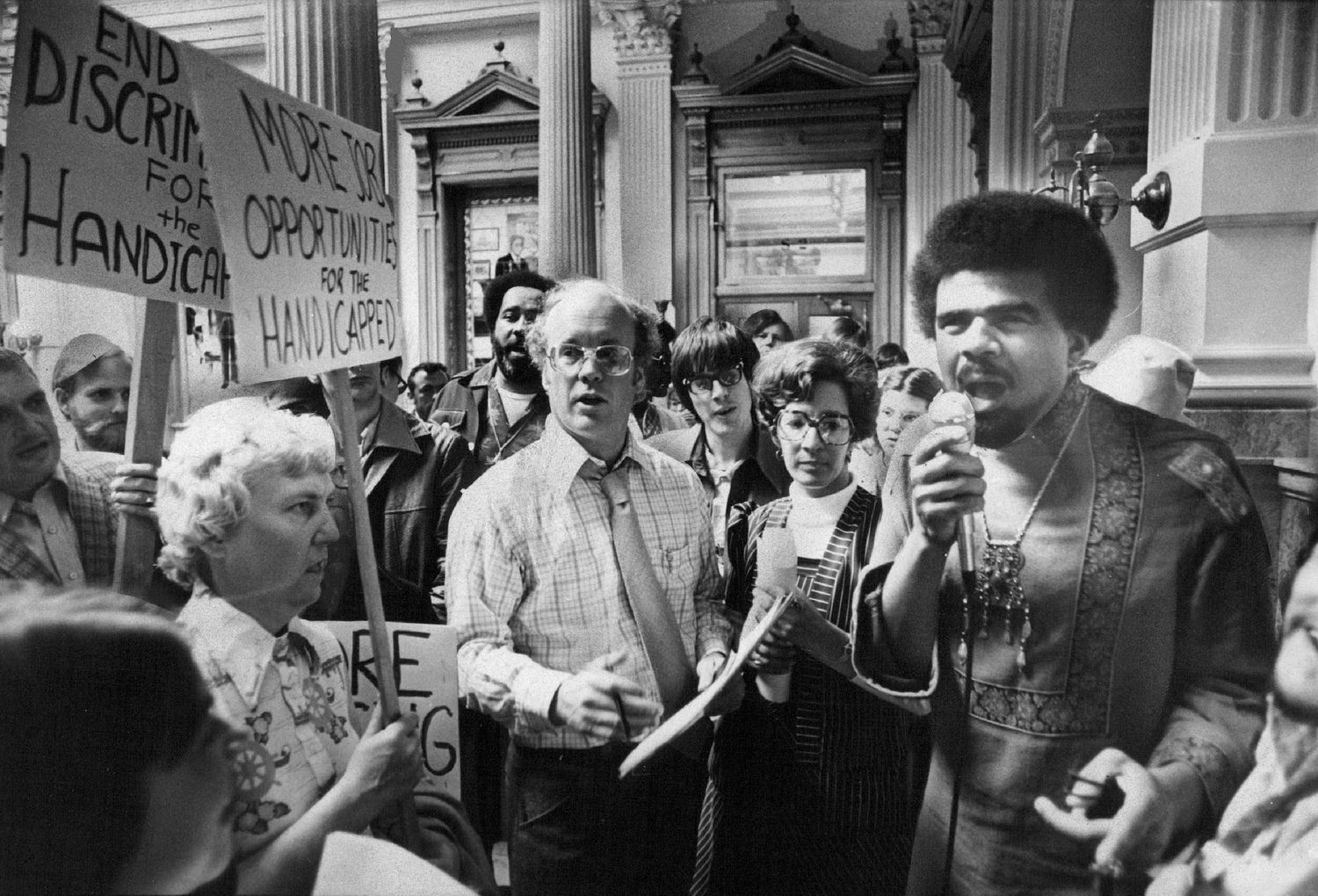
Don Galloway broke barriers as a blind civil rights activist who pushed for racial and labor justice within the disability rights movement. He was the first blind Peace Corps Director and fought discriminatory policies in government service. His landmark 1993 court victory protected the right of blind citizens to serve on juries.
Throughout his entire life, Donald Galloway fought tirelessly for both racial equality and disability rights. He became disabled when he was thirteen years old, after being struck in the eyes by a friend’s bow and arrow. Rather than let his disability limit him, he channeled his energy into advocacy, and served as a junior member on both the local NAACP chapter and the National Federation for the Blind.
After earning his master's degree in social work, Galloway joined the Berkeley Center for Independent Living as director of services for blind people, working alongside Ed Roberts. He was one of the few non-white disabled advocates in the community, and rallied to ensure that the independent living movement included the voices and perspectives of people of color.
Galloway held several influential positions throughout his career. He served as executive director for the Colorado Governor's Council on Disability in Denver, directed the Center for Independent Living's Washington, D.C. branch, and worked with several governmental agencies on disability inclusion. He was the first blind person appointed as a Peace Corps Director, serving in Jamaica where he managed 160 volunteers.
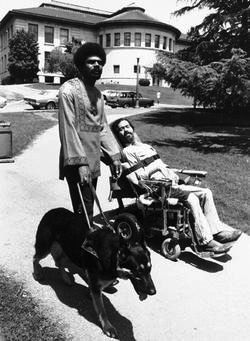
A black and white photograph of Galloway, left, with his guide dog standing next to Ed Roberts (right). Photo Source: The Center for Learning Equity
Galloway challenged discriminatory laws that prevented disabled people from serving in the United States Foreign Service. He pushed for labor equity for disabled people beyond affinity-based roles. "My belief system is a person with a disability shouldn't be hired to just work with disabled organizations and on disabled issues. That may be the first step, but we should branch out," he said, adding, "And that's the key of success to me – is to see how we bring in other brothers and sisters to work in all capacities."
One of his most significant contributions to the labor movement came through his personal battle with the justice system. In 1991, when called for jury duty, he was dismissed by the judge solely because he was blind and accompanied by his guide dog. Galloway fought back, filing a lawsuit against the District. In 1993, a District judge ruled that automatically disqualifying blind people from jury service was unconstitutional. This landmark decision reinforced that juries should reflect all citizens, including disabled people.
Galloway passed away in 2011. His legacy lies in his understanding that civil rights movements cannot exist in isolation. By standing at the intersection of racial justice and disability justice, he helped bridge gaps between communities and ensured that Black voices became an integral part of disability advocacy. His work in both federal government and local community created lasting change.
Reflection Questions
Galloway emphasized how different forms of discrimination intersect and compound. How do you see these intersections playing out in your community, and what can you do to address them?
Consider how organizations serving marginalized communities might inadvertently exclude some members of those communities. How can we make our advocacy more inclusive?
Never miss a story
Get stories of overlooked and untold Black history in your inbox, free every week.