Dorothy Lee Bolden
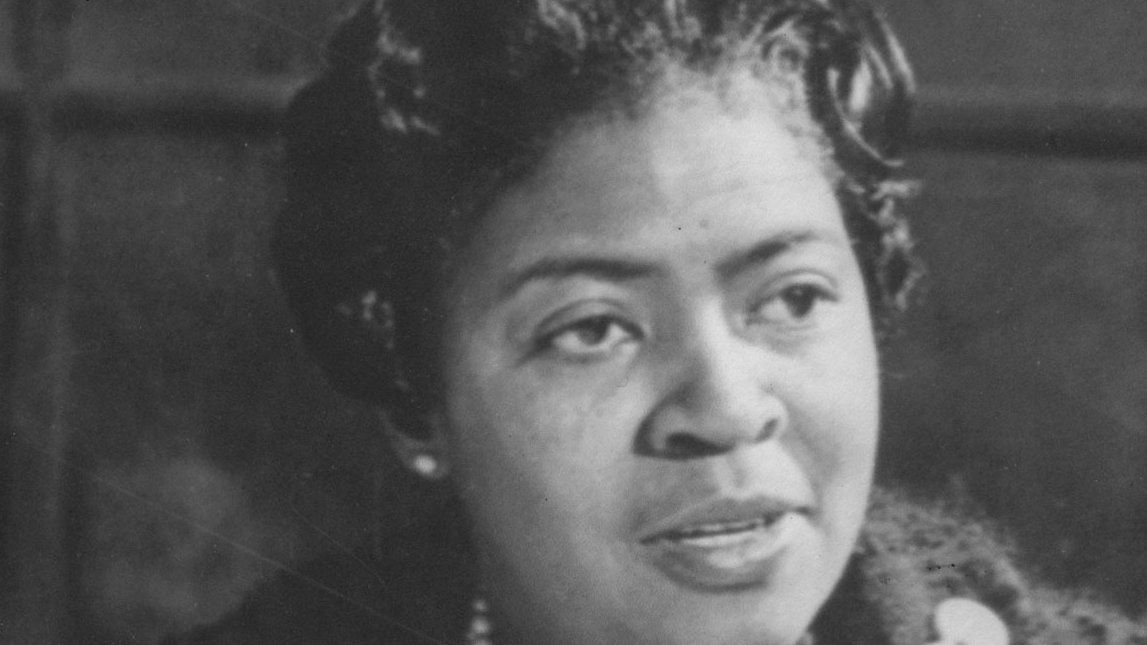
Day 28: Dorothy Lee Bolden
Dorothy Lee Bolden founded the National Domestic Workers Union of America (NDWUA) in 1968, organizing workers who had long been excluded from labor protections.
Her innovative organizing strategies and insistence on connecting voting rights to workers' rights created a model for empowering marginalized workers.
Dorothy Lee Bolden was born in Atlanta in 1924 to working-class parents: her mother was a housekeeper, and her father a chauffeur. When she was nine years old, she started working as a housekeeper for a local family while going to school. Ultimately, she dropped out after ninth grade to focus on her job.
Essentially, this was the start of a 49-year career that would shape her understanding of the profession's dignity and challenges. "A domestic worker is a counselor, a doctor, a nurse," she later explained. "She cares about the family she works for as she cares about her own." Yet she keenly recognized that domestic workers "have never been recognized as part of the labor force."
Her first act of workplace resistance came in the late 1940s when she refused a white employer's demand to stay late and wash dishes. The response was swift and punitive – she was arrested and put until psychological evaluation. "They told me I was crazy because I had talked back to a white woman, and called in some psychiatrists to prove it," Bolden recalled. "A white woman's word was gospel... This was the way you got locked up... This was the system." This formative experience revealed the intersection of racial and labor oppression that defined domestic work.
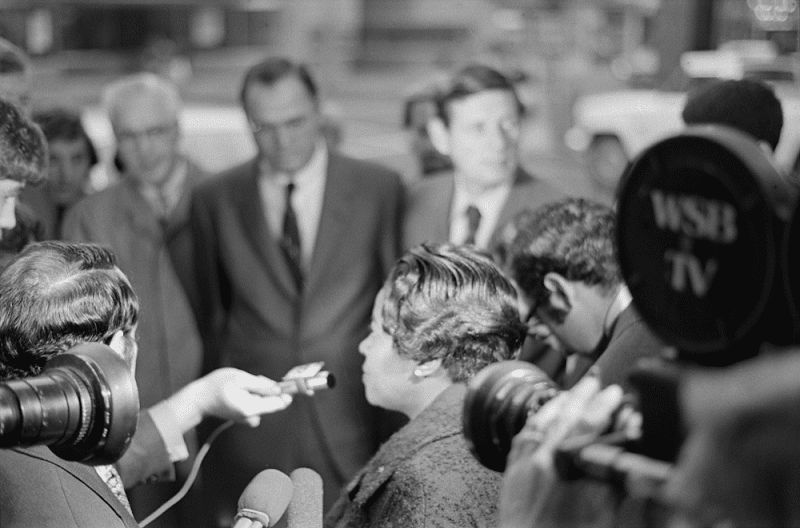
A black and white photograph of Dorothy Bolden, center, speaking with reporters at the National Conference of Mayors Meeting, 1971. Photo Source: Kenan Research Center
Deeply inspired by the Civil Rights Movement unfolding around her in Atlanta, Bolden wanted to create an impact in her own community. She reached out to Dr. Martin Luther King Jr. offering to mobilize the domestic workers. With his support, hit the streets. She knew that domestic workers had very little free time, only idling while sitting on the bus for their daily commute. So, she rode buses all across the city to meet other workers, using the buses as her office to build relationships, identify common concerns, and recruit women into an emerging movement.
The domestic workers Bolden spoke with described brutal conditions—13-hour days for as little as $3.50, with no benefits, job security, or legal protections. Recognizing both the moral and strategic imperative of political power, Bolden insisted that domestic workers register to vote, connecting labor rights directly to political engagement.
In 1968, after extensive groundwork, Bolden founded the National Domestic Worker's Union of America. Rather than relying solely on traditional union tactics, which rally energy behind a defined set of employers, it focused on establishing professional standards, minimum wage requirements, and collective bargaining approaches adapted for workers with multiple employers. "We set standards," Bolden explained. "If you want a maid who's professional, who knows her job, who doesn't steal, who comes to work regularly, who does what you want her to do, then you must pay."
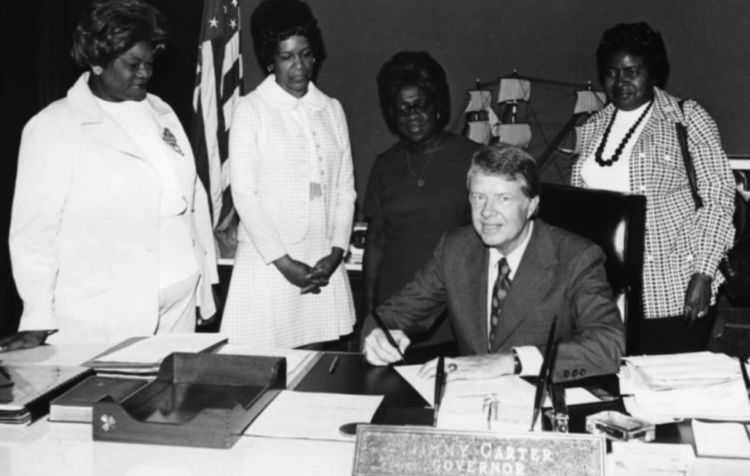
A black and white photograph of Bolden, right, watching Gov. Jimmy Carter signed a proclamation in 1972 establishing Maid's Honor Day to honor outstanding women in the field of domestic labor along with three other women. Photo Source: Jezebel
Her approach worked. The NDWUA expanded to ten cities with 13,000 members. Under Bolden's leadership, Atlanta domestic workers secured a 33% wage increase over just two years, along with access to workers' compensation and Social Security benefits.
Bolden's growing influence earned her national recognition, including an appointment to a Nixon Administration advisory committee on social services and welfare. She leveraged this platform to advocate for domestic workers at the highest levels of government. And through it all, Bolden balanced raising six children with her second husband, Abram Thompson.
Dorothy Lee Bolden passed away in July 2005, and left behind not just improved conditions for domestic workers but a revolutionary organizing model. Her approach—organizing through social networks, connecting labor rights to voting power, establishing professional standards, and adapting union strategies for non-traditional workplaces—continue to influence labor organizing today.
Reflection Questions
Bolden organized workers who were traditionally seen as "unorganizable." What groups of workers today might be considered difficult to organize, and how might Bolden's strategies be applied to help them?Consider how Bolden used daily spaces like bus rides to build community and organize. What spaces in your daily life could become sites of organizing and community building?
Learn More
Watch this short video of how Dorothy Bolden unionized domestic workers.Listen to this comprehensive interview with Bolden, broken down into chapters for different parts of her lifeExplore the archives of the National Domestic Worker's Union of America, preserved at Georgia State University's Southern Labor ArchiveRead this reflection of how Bolden’s work inspired Jacquelyn Arnold, a childcare provider and one of the longest standing members of the National Domestic Workers Alliance in Atlanta, GA.
Never miss a story
Get stories of overlooked and untold Black history in your inbox, free every week.