Florynce “Flo” Kennedy
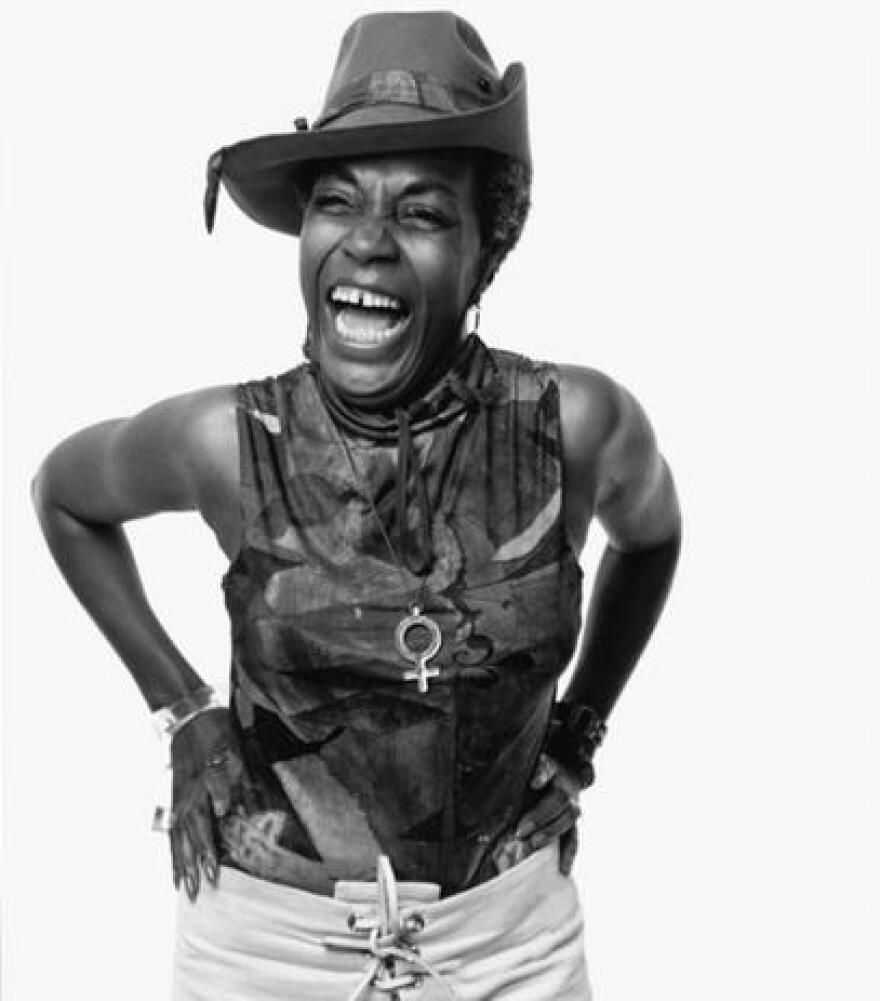
In her legal career, Kennedy transformed abortion rights by pioneering sex discrimination arguments under the equal protection clause, directly influencing Roe v. Wade.
Her theatrical activism created a blueprint for intersectional advocacy that connected racial justice, feminism, and economic rights when these movements rarely collaborated.
Florynce "Flo" Kennedy was born in 1916 in Kansas. Growing up, her family actively resisted racism despite violent threats, likely influencing Kennedy’s sense of justice that would define her career. In 1942, she moved to New York, working various jobs while putting herself through school at Columbia University.
When she applied to the university’s law school, she was initially rejected. With top marks in undergraduate, she was surprised to hear this – and requested a meeting with the administration to learn why. That’s when the dean admitted she was denied because she’s a woman. Kennedy, recognizing the intersectional nature of discrimination, threatened to sue on the grounds of both race and gender. "Columbia first turned me down because I was a woman," she later recalled, "then relented because I threatened to denounce the Law School as racist." The school promptly admitted her, and in 1951, she became one of the few Black women lawyers of her era.
After establishing her own practice, Kennedy took on cases connected to civil rights and social justice that other attorneys avoided. By 1964, she had published an article advocating for liberalized abortion laws, positioning herself at the forefront of reproductive rights activism years before Roe v. Wade.
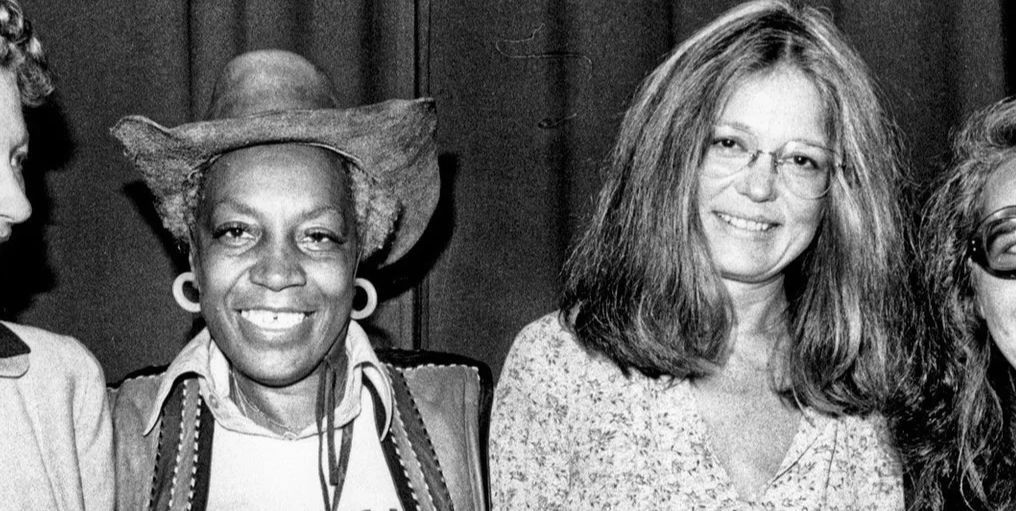
A black and white photograph of Flo Kennedy, left, in cowboy hat and best, T-shirt and hoop earrings and Gloria Steinem, right, in floral patterned top and glasses. Photo Source: New York Public Library.
In 1967, she attended the first meeting of the National Organization for Women (NOW), a feminist organization, while helping organize the first national Black Power Conference. She proposed that NOW ally with Black Power advocates to create a more comprehensive movement against oppression, but the idea was rejected. This would encourage her to create two organizations committed to both gender and racial equity: the Feminist Party in 1971 and the National Black Feminist Organization in 1973.
Her most significant legal contribution came as the only Black lawyer on the legal team that brought Abramowicz v. Lefkowitz, the first federal abortion litigation from the women's liberation movement, to the New York State Supreme Court. The groundbreaking case represented hundreds of plaintiffs who had been or could become pregnant. Kennedy argued that abortion restrictions were a form of gender-based discrimination under the equal protection clause of the Constitution. The case became moot because New York liberalized its abortion laws during the trial, but the legal reasoning Kennedy brought influenced cases nationwide, including Roe v. Wade.
Kennedy’s activism was in the courtrooms and the streets. Through the Feminist Party, she’d organize major protests against sociopolitical moments, like the Catholic Church’s support of anti-abortion legislation, and demanded major media companies give equal coverage to 1972 presidential candidate Shirley Chisholm, who was nominated for the role by the Party. You can watch a recording of her protests here, which, as the next paragraph explains, includes protestors using colorful language.
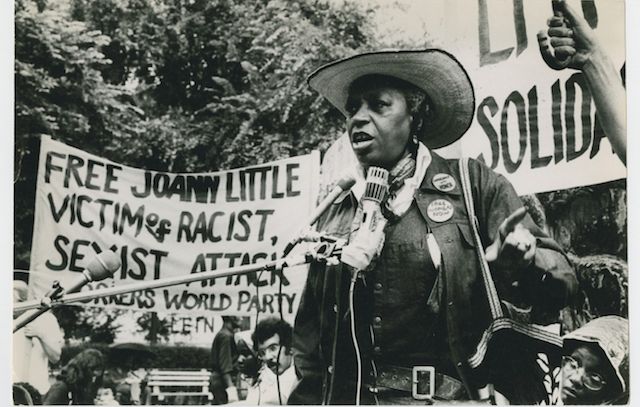
A black and white photograph of Kennedy, center, at a protest rally in support of Joann Little, a young African American accused of murdering her jailor-rapist in 1974.
She was theatrical in her protest. She intentionally adopted a flamboyant style – including cowboy hats and large false lashes – to keep people uncomfortable, and used colorful language and dramatic direct actions to “draw attention to injustices of all kinds." Once, she organized a "pee-in" at Harvard Yard in 1973 (where protestors dumped fake urine on a building’s front steps) to highlight the lack of women's bathrooms in university buildings. People magazine described her in 1974 as “the biggest, loudest and, indisputably, the rudest mouth on the battleground where feminist activists and radical politics join in mostly common cause.”
Kennedy’s legal advocacy in the late 1970s and 1980s continued with ambitious projects, including a suit challenging the Catholic Church's tax-exempt status for using funds to influence abortion legislation. She also once represented H. Rap Brown and the Black Panthers. She published The Pathology of Oppression, her autobiography, Color Me Flo, and hosted The Flo Kennedy Show on Manhattan Cable Television in the 1990s, where she continued to rally viewers to take action.
Kennedy passed in 2000. Her legacy lives on through the legal precedents she helped establish, her insistence on connecting different liberation movements, and her bold, unapologetic activism. Kennedy understood that racism, sexism, and economic oppression were interconnected systems that required unified resistance – and was worth making a lot of noise about.
“You’ve got to rattle your cage door. You’ve got to let them know that you’re in there, and that you want out. Make noise. Cause trouble. You may not win right away, but you’ll sure have a lot more fun.”
Flo Kennedy
Reflection Questions
What can today's social justice movements learn from Kennedy’s strategy of combining legal expertise with theatrical activism to advance multiple causes simultaneously? How did Kennedy’s early recognition of the connections between racial, gender, and economic oppression anticipate and shape modern intersectional activism?
Learn More
Read Color Me Flo, an autobiography written by Flo Kennedy.Read Florynce Flo Kennedy: The Life of a Black Feminist Radical by Sherie M. Randolph.Read The Verbal Karate of Florynce R. Kennedy, Esq., a reflection written by Gloria Steinem.Watch The Glorias, a film inspired by the life of Gloria Steinem that features some of her co-conspirators, including Kennedy.Watch an episode of The Flo Kennedy Show.
Never miss a story
Get stories of overlooked and untold Black history in your inbox, free every week.