Lift Every Voice and Sing
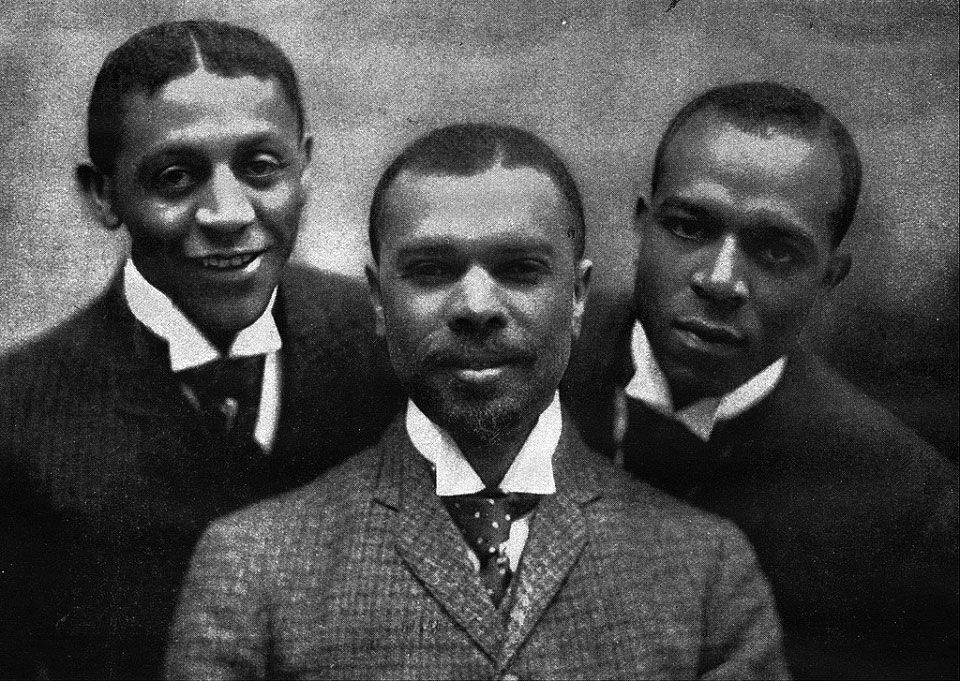
A black and white portrait of composers and producer Bob Cole, James Weldon Johnson, and J. Rosamond Johnson (from left) from Jan. 1, 1900. Image Source: Schomburg Center for Research in Black Culture, Photographs and Prints Division, New York Public Library.
On February 12, 1900, five hundred children gathered at the segregated Stanton School in Jacksonville, Florida, to celebrate Abraham Lincoln's birthday. Their voices rose together in the first public performance of a song that would echo through generations. James Weldon Johnson, the school's principal, had written the words. His younger brother, John Rosamond Johnson, had composed the music. Neither man could have predicted that their original song, “Lift Every Voice and Sing” would still resonate more than a century later.
James Weldon Johnson was already an accomplished figure when he penned the lyrics in late 1899. Born in 1871, he had trained as a lawyer and worked as an educator, but his true passion lay in writing. His brother John, born in 1873, had studied at the New England Conservatory of Music and was building a career spanning vaudeville, traditional theater, and spirituals. The brothers had collaborated before and would continue working together throughout their lives, convinced that artistic excellence could advance Black Americans' standing in society.
James Weldon Johnson wanted to create something meaningful for the Lincoln birthday celebration, something that would honor what his students and their families lived through daily in segregated Florida. After the students performed it, the brothers didn’t give it much thought. “Shortly afterwards my brother and I moved from Jacksonville to New York, and the song passed out of our minds," Johnson wrote in 1935. "But the school children of Jacksonville kept singing it, they went off to other schools and sang it, and they became teachers and taught it to other children." Within twenty years, people were singing it throughout the South and beyond. The song spread organically, carried by the children who had first learned it and by teachers who recognized its power.
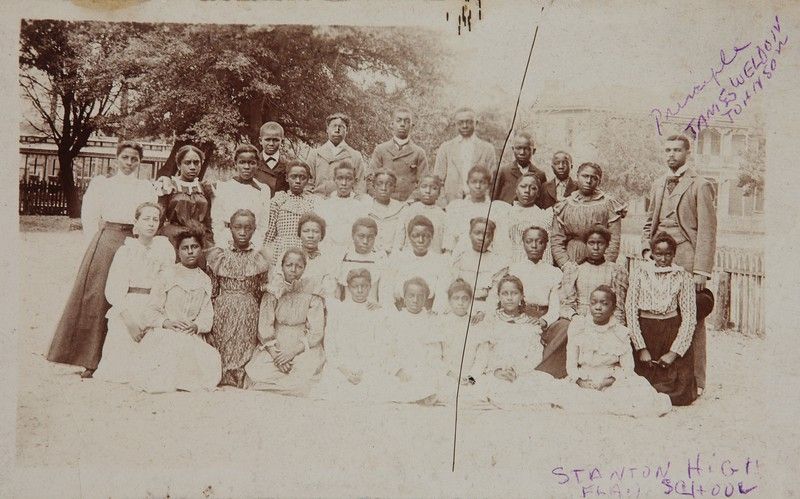
A black and white photograph of James Weldon Johnson, then principal at theStanton School, posing for a class picture with about two dozen students outdoors. Photo Source: Yale University Library
In 1905, Booker T. Washington endorsed the song. By 1919, the NAACP adopted it as its official anthem. By then, James Weldon Johnson had become the organization's first Black executive secretary. He would go on to write novels, poetry, and cultural criticism, serving as a diplomat and the first Black faculty member at New York University. But this early collaboration with his brother remained special to him. "The lines of this song repay me in an elation, almost of exquisite anguish, whenever I hear them sung by Negro children," he reflected.
The song starts with a prompt: "Lift every voice and sing." The opening stanza calls for joy and hope, looking toward the rising sun of a new day. But the second verse shifts, acknowledging "the dark past" and a road marked by tears and blood. The third verse becomes a prayer, asking God for strength and guidance to remain faithful to the nation and to the ideals of liberty. The structure moves from celebration through memory to dedication—a trajectory that captures both the heartbreak and resilience of being Black in America. This interactive story on CNN breaks down the lyrics and explains the meaning behind each stanza.
“Lift every voice and sing
Till earth and heaven ring,
Ring with the harmonies of Liberty;
Let our rejoicing rise
High as the listening skies,
Let it resound loud as the rolling sea.
Sing a song full of the faith that the dark past has taught us,
Sing a song full of the hope that the present has brought us.
Facing the rising sun of our new day begun,
Let us march on till victory is won.”
John Rosamond Johnson's musical composition matched his brother's words in complexity and emotional range. He applied both his training in classical music and the traditions of Black spirituals and hymns. The melody builds and swells, demanding both technical skill and emotional commitment from performers. It wasn't designed to be easy or casual. The Johnson brothers created something that required effort; something worthy of the moment they sought to honor.
During the Civil Rights Movement of the 1950s and 1960s, the song found renewed purpose. Marchers sang it at protests. Churches incorporated it into services. It appeared at rallies and meetings, a musical thread connecting past struggles to present action. People who had learned it as schoolchildren taught it to a new generation facing different battles against the same fundamental injustices.
The song's popularity organically led it to become considered the "Black National Anthem". "The Star-Spangled Banner" became America's national anthem in 1931. By then, "Lift Every Voice and Sing" had already been circulating for over thirty years, and was already established as a uniting song in the same spaces we see the National Anthem today.
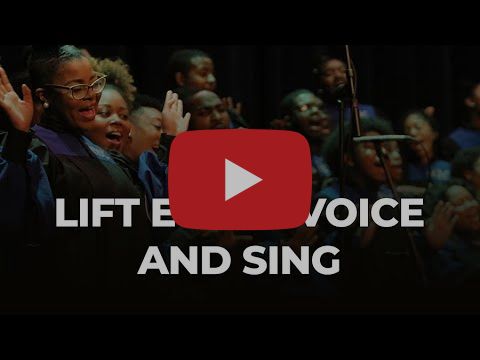
Watch the Howard Gospel Choir of Howard University sing “Lift Every Voice and Sing”.
The song appears regularly at historically Black colleges and universities, at cultural celebrations, in churches, and at events marking significant moments in Black history. Artists from Kim Weston to Gladys Knight to Beyoncé have recorded versions, each bringing their own interpretation while honoring the song's roots.
The NFL began playing it before games in 2021 as part of its acknowledgement of racial inequity. When they did, conservatives were quick to attack it as “woke” and “divisive.” But others viewed it as a long-overdue recognition of the song's place in American culture. In the same year, Representative James Clyburn introduced a bill to Congress hoping to establish "Lift Every Voice and Sing" as the national hymn—not to replace the national anthem, but to stand alongside it as recognition of its historical influence. The proposal sparked debate about what symbols the nation should embrace and whose stories deserve official recognition.
The Stanton School children who first sang the song in February 1900 could not have known they were launching something that would outlast them. They simply learned the words their principal had written and the melody his brother had composed, then shared them with others. That act of sharing, repeated thousands of times over more than a century, transformed a school celebration song into something much larger—a statement of identity, resilience, and hope that continues to resonate wherever people gather to assert their dignity and demand justice.
Reflection Questions
The Johnson brothers created "Lift Every Voice and Sing" for a specific school celebration, yet it spread organically through communities over decades. Can you think of other songs that have quickly spread like this?The popularity of "Lift Every Voice and Sing" was sparked in classrooms. In which other ways do schools move digital, justice and representation forward for marginalized communities?"Lift Every Voice and Sing" served as a source of inspiration when Black Americans were excluded from many aspects of public life. What songs give you hope, or make you feel a sense of togetherness and belonging?
Learn More
Listen to Kierra Sheard sing the song at the 111th NAACP Convention.Explore user-submitted interpretations of the song’s lyrics to get a sense of how this song resonates with a wide audience.The Stanton School was Florida’s first official school for African Americans and was designated to the National Register of Historic Places in 1983. Learn more about its history and steps to preserve it.There’s something magical when crowds start singing this song unprompted. Here are videos of people singing it at gatherings in DC, Holland, Chicago and other protests.
Never miss a story
Get stories of overlooked and untold Black history in your inbox, free every week.