Loving Day
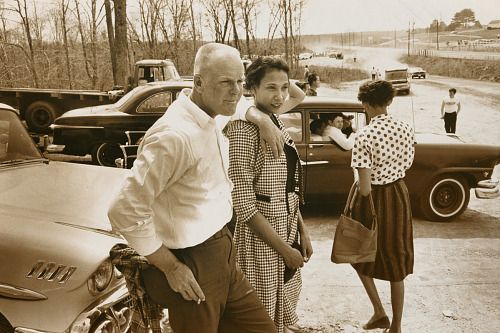
On June 12, 1967, the U.S. Supreme Court justices ruled in favor of Loving v. Virginia for interracial marriages. The unanimous decision upheld that distinctions drawn based on race were not constitutional. This ruling invalidated anti-miscegenation laws across the United States, affecting 16 states that still banned interracial marriage at the time. Loving Day is an annual celebration held on this date.
On a summer night in 1958, police unlawfully entered the home of Mildred and Richard Loving. They stormed in at 2am intentionally so they could catch the couple in bed together. Their crime: the interracial couple had married five weeks prior, which was illegal in the state. More than six decades later, their union and subsequent Supreme Court case continues to be "one of the most significant legal decisions of the civil rights era" (History).
Richard Loving and Mildred Jeter were a couple from Caroline County, Virginia. Richard, who identified as white, and Mildred, a woman of mixed African American and Native American ancestry, were longtime friends who had fallen in love. They married on June 2, 1958, in Washington, D.C., where interracial marriage was legal, and then returned home to Virginia, where it was illegal.
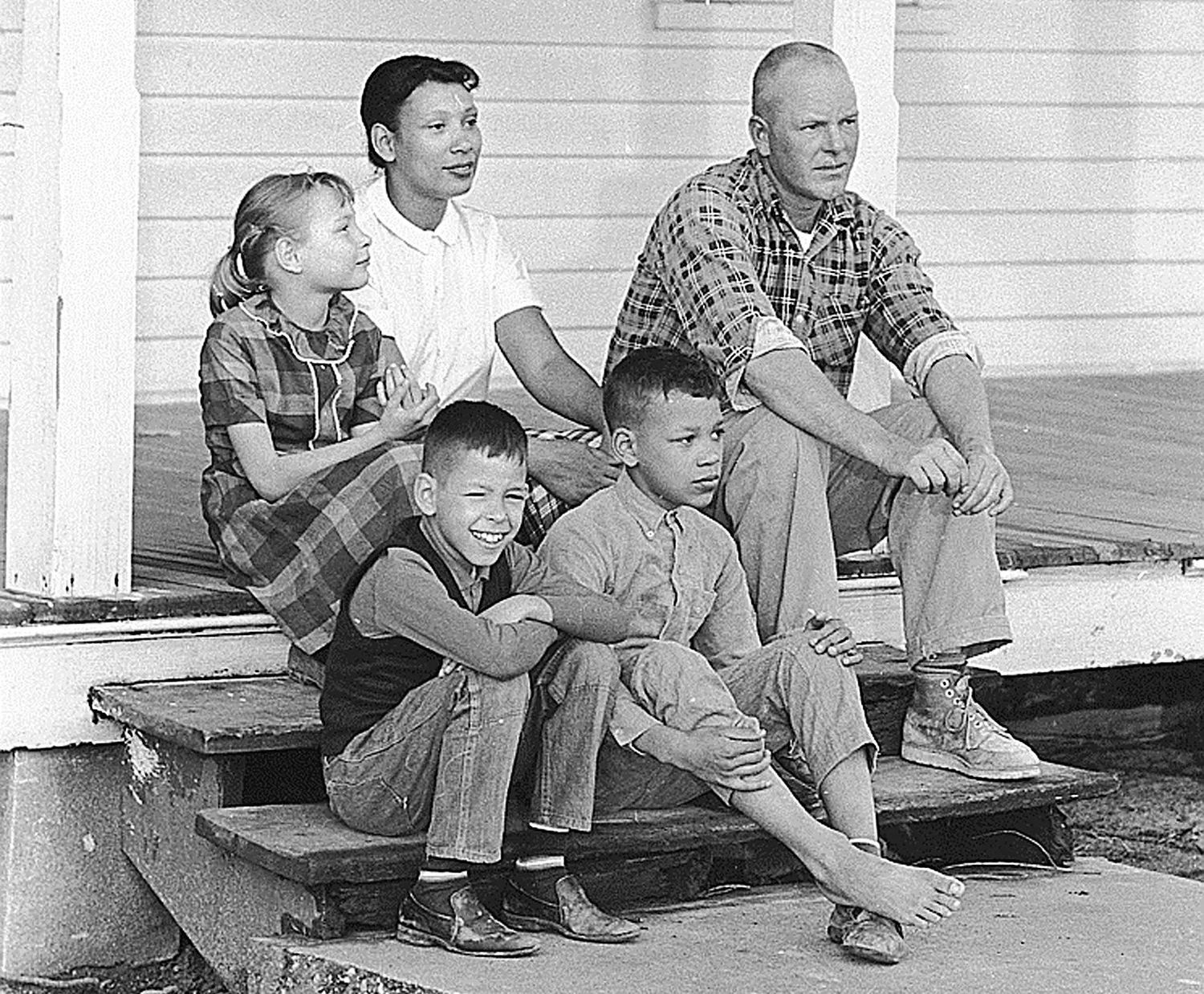
A black and white photograph depicting Richard and Mildred Loving at their home in Central Point, Va., with their children, from left, Peggy, Donald and Sidney, in 1967.
Just five weeks after their wedding, Richard and Mildred were indicted on charges of violating Virginia's Racial Integrity Act of 1924, which deemed interracial marriages a felony punishable by imprisonment. On January 6, 1959, they pleaded guilty and were sentenced to one year in prison. However, the trial judge suspended the sentence on the condition that the Lovings leave Virginia and not return together for 25 years. In his ruling, Judge Leon M. Bazile wrote: "Almighty God created the races white, black, yellow, malay and red, and he placed them on separate continents. And, but for the interference with his arrangement, there would be no cause for such marriage. The fact that he separated the races shows that he did not intend for the races to mix."
The couple relocated to Washington, D.C., but struggled with the separation from their families and home. In 1963, after years of exile, Mildred Loving wrote a letter to U.S. Attorney General Robert F. Kennedy asking for help. Kennedy referred the Lovings to the American Civil Liberties Union, which agreed to take their case. ACLU lawyers Bernard S. Cohen and Philip J. Hirschkop filed a motion in state court to vacate the judgment and set aside the sentence on the grounds that the anti-miscegenation statutes violated the Fourteenth Amendment (Read the full court documents).
The state created a defense that compared anti-miscegenation statutes to the right to prohibit incest, polygamy, and underage marriage. They emphasized that state of Virginia's rules against interracial marriages, echoed by many other states until this ruling, were meant "to preserve the racial integrity of its citizens," and to prevent "the corruption of blood," "a mongrel breed of citizens," and "the obliteration of racial pride" — language that was explicitly an endorsement of white supremacy doctrine. They argued that children of interracial marriages were the victims of crimes like these because they’d be ineligible to possess land rights under Virginia law, and should not have to suffer from their parents' decision to wed. You can listen to audio from this court case on NPR.
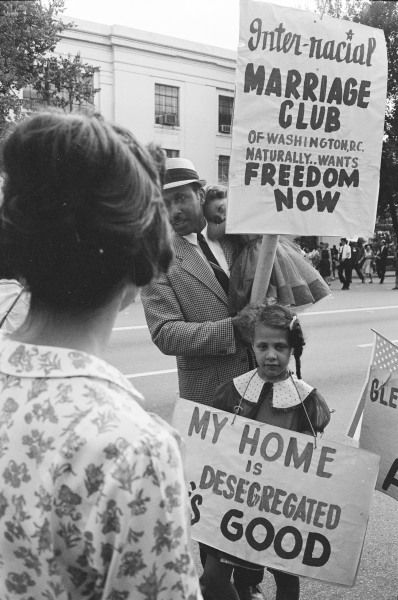
A black and white photograph of members of the Inter-racial Marriage Club, including a man with his two young children, protesting bans on inter-racial unions and advocating for desegregated homes on the street in 1963. Photo Source: National Archives, Records of the United States Information Agency
During oral arguments, ACLU attorney Philip Hirschkop stated: "We fail to see how any reasonable man can but conclude that these laws are slavery laws, were incepted to keep slaves in their place, were prolonged to keep the slaves in their place, and in truth, the Virginia law still views the Negro race as a slave race. These are the most odious laws to come before the court. They robbed the Negro race of its dignity, and only a decision which will reach the full body of these laws in the State of Virginia will change that" (NPR).
The U.S. Supreme Court ruled unanimously in favor of the Lovings on June 12, 1967. Chief Justice Earl Warren wrote the opinion, declaring: "Marriage is one of the 'basic civil rights of man,' fundamental to our very existence and survival... Under our Constitution, the freedom to marry, or not marry, a person of another race resides with the individual and cannot be infringed by the State." As a result, sixteen states were forced to overturn their anti-miscegenation laws. Alabama was the last state to remove the language from its state constitution in 2000.
This case was undoubtedly a monumental win for civil rights. It didn’t just move forward racial equity for Black communities, but challenge anti-miscegnation laws used against Japanese Americans and Native communities. Richard Loving passed away in 1975, but Mildred lived to see the impact of their case continue to influence the legal system. Before her death in 2008, she issued a statement supporting marriage equality for same-sex couples, noting that she believed "all Americans, no matter their race, no matter their sex, no matter their sexual orientation, should have that same freedom to marry."
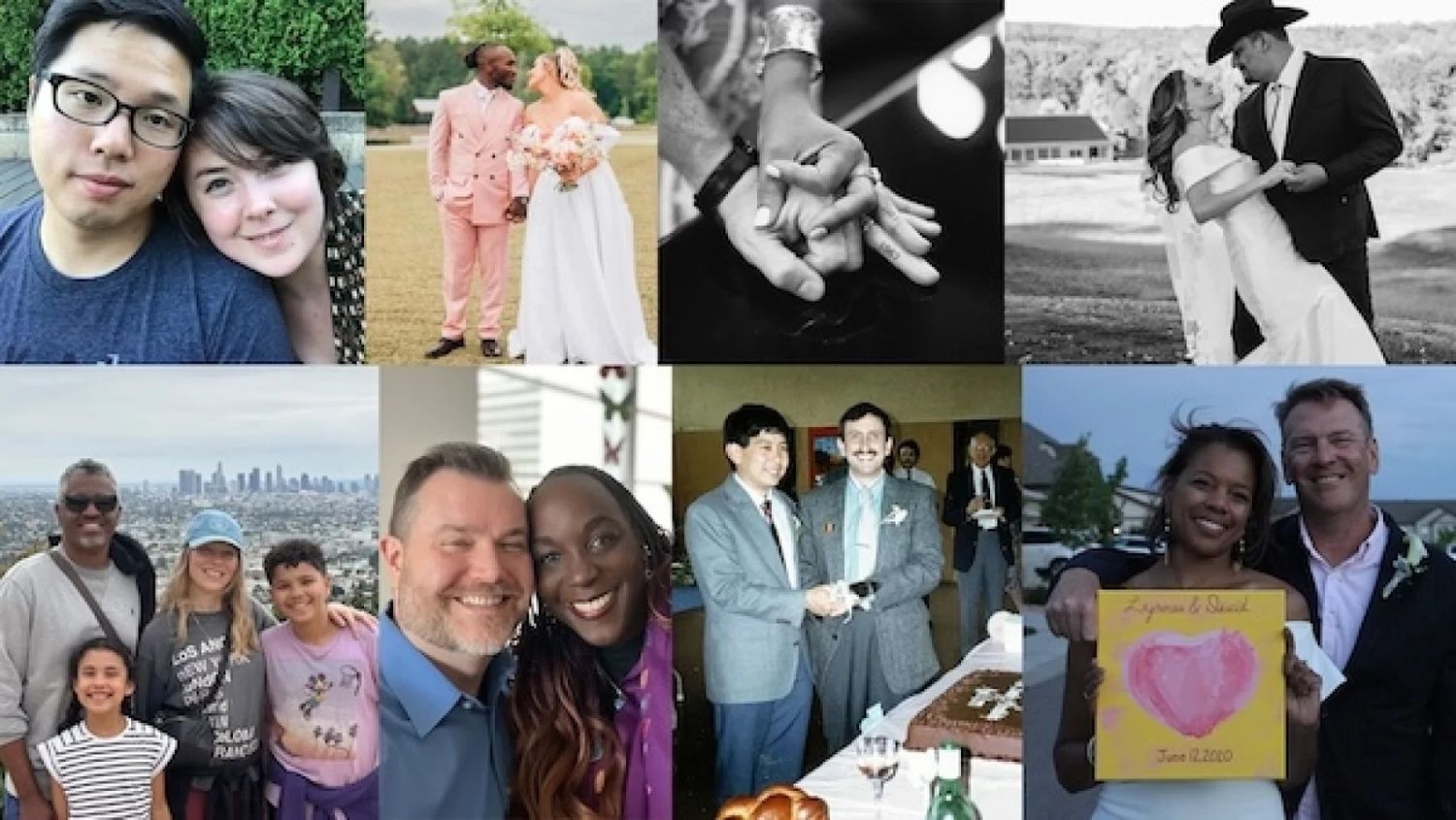
Read stories from couples on what Loving Day means to them in this NPR article from 2025.
A collage of photographs from NPR readers sent to the publication for their Loving Day Top row (left to right): Ayla Ludwig and her husband, Alia and Donovan Campbell, two hands showing matching tattoos on the ring finger, and Nina and Daniel Solis. Bottom row (left to right): Stacey Manley and his family, Isaiah Schauer and his wife, Craig Wiesner and his husband, Derrick Kikuchi, and Lynnea and David Hutton. Image Source: NPR.
The idea for Loving Day as a commemoration came from Ken Tanabe, a student at Parsons the New School for Design. In 2004, Tanabe created Loving Day as part of his senior thesis project. Growing up as a person of mixed-race heritage, he had never heard of the Lovings or their Supreme Court case. When he discovered their story, he was struck by how this pivotal moment in American history—one that directly affected people like him—remained largely unknown to the public. He created a website to educate people about the history and encouraged people to host their own Loving Day gatherings on June 12 each year, hoping to create an annual tradition.
What began as a college thesis project has grown into a nationwide observance, with Loving Day celebrations now held in cities across the country. The day has not been formally recognized as a state or federal holiday, but some cities and states have issued proclamations acknowledging it. Regardless, it still carries meaning for all those who have been discriminated against for who they love.
As of 2015, 11 million people, or about 10% of all married people in the U.S., are in a mixed-race or interethnic marriage. 17% of all newlyweds from this year were married to someone of a different race or ethnicity, a fivefold increase from 3% in 1967. The story of the Loving’s bravery and commitment forever changed the rights of Black people in the U.S., and laid a foundation for generations of couples to live freely and without fear.
Reflection Questions
Why do you think it took until 2000 for Alabama to remove anti-miscegenation language from its state constitution, more than 30 years after the Supreme Court ruling?Ken Tanabe created Loving Day because he had never learned about the Lovings in school. What important histories in your own community or heritage have been overlooked, and how can you help share them?
Learn More
Teachers: here is a great middle school lesson plan to teach about Loving Day.Contemporary research suggests that Mildred Loving wasn’t actually Black, but of Native heritage, and that Richard Loving was often questioned on his own white identity. These nuances to the story emphasize how flimsy the social constructs of race are and how difficult they are to police. Learn more in this article by writer Arica L. Coleman.Watch The Loving Story on HBO, a documentary highlighting the Supreme Court case.Watch Loving, a dramatization of the Loving’s story, on Netflix.If you want to read more, I recommend this children’s book and this photo essay!
Never miss a story
Get stories of overlooked and untold Black history in your inbox, free every week.