Mary McLeod Bethune
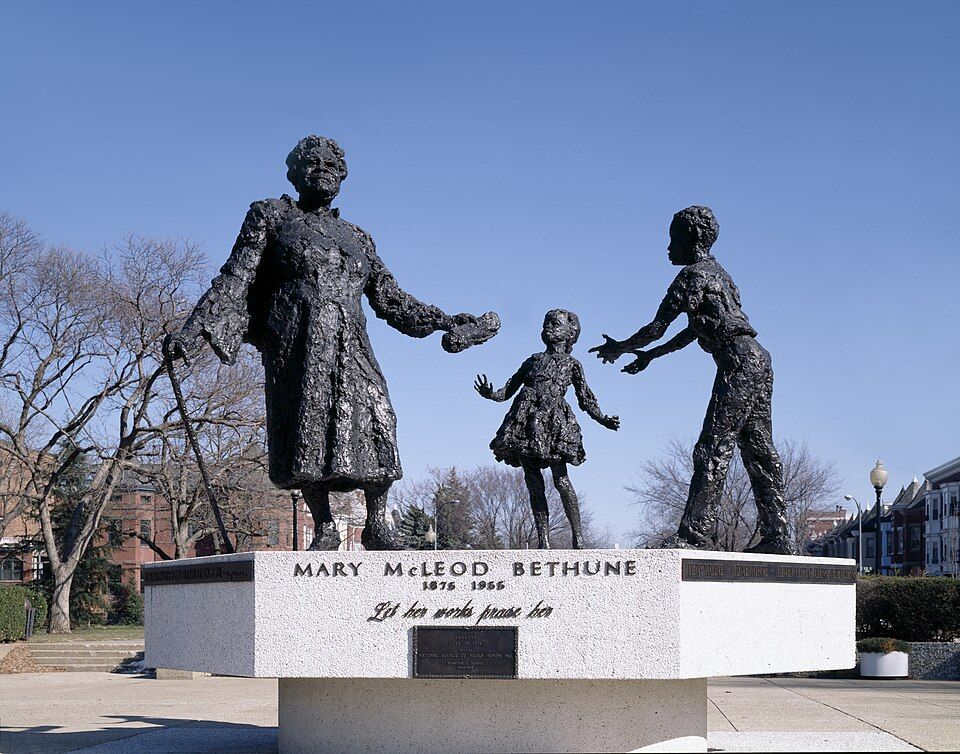
A photograph of the Mary McLeod Bethune Memorial in Washington, D.C, which depicts three bronze cast statues, one of Bethune (left) and two children (right), one of whom is reaching toward a diploma in Bethune’s statue’s hand. Photo Source: Library of Congress
Mary McLeod Bethune was a world-renowned educator, civil rights leader, women's rights activist, presidential advisor, and public servant who dedicated her life to uplifting Black Americans. From founding a school with only $1.50 to advising presidents and leading national organizations, Bethune broke barriers throughout her life. Her unwavering faith, determination, and commitment to service lives on through Bethune-Cookman University, the National Council of Negro Women, and the monuments erected in her honor.
Mary Jane McLeod was born on July 10, 1875, in Mayesville, South Carolina, as the fifteenth of seventeen children. Her parents, Samuel and Patsy McLeod, had been enslaved but by the time Mary was born, they were freed and owned a small farm. Growing up during a difficult time when Black Americans faced discrimination and violence, Mary was curious and eager to learn.
Bethune attended the Trinity Presbyterian Mission School in Mayesville from 1882 to 1886. She excelled academically, earning her a scholarship to Scotia Seminary for Negro Girls in Concord, North Carolina, where she studied from 1887 to 1894. She then spent a year at the Moody Bible Institute in Chicago, where she was the only Black student. During her time at these schools, Mary developed a passion for education and wanted to provide a more culturally responsive learning experience for Black girls like her.
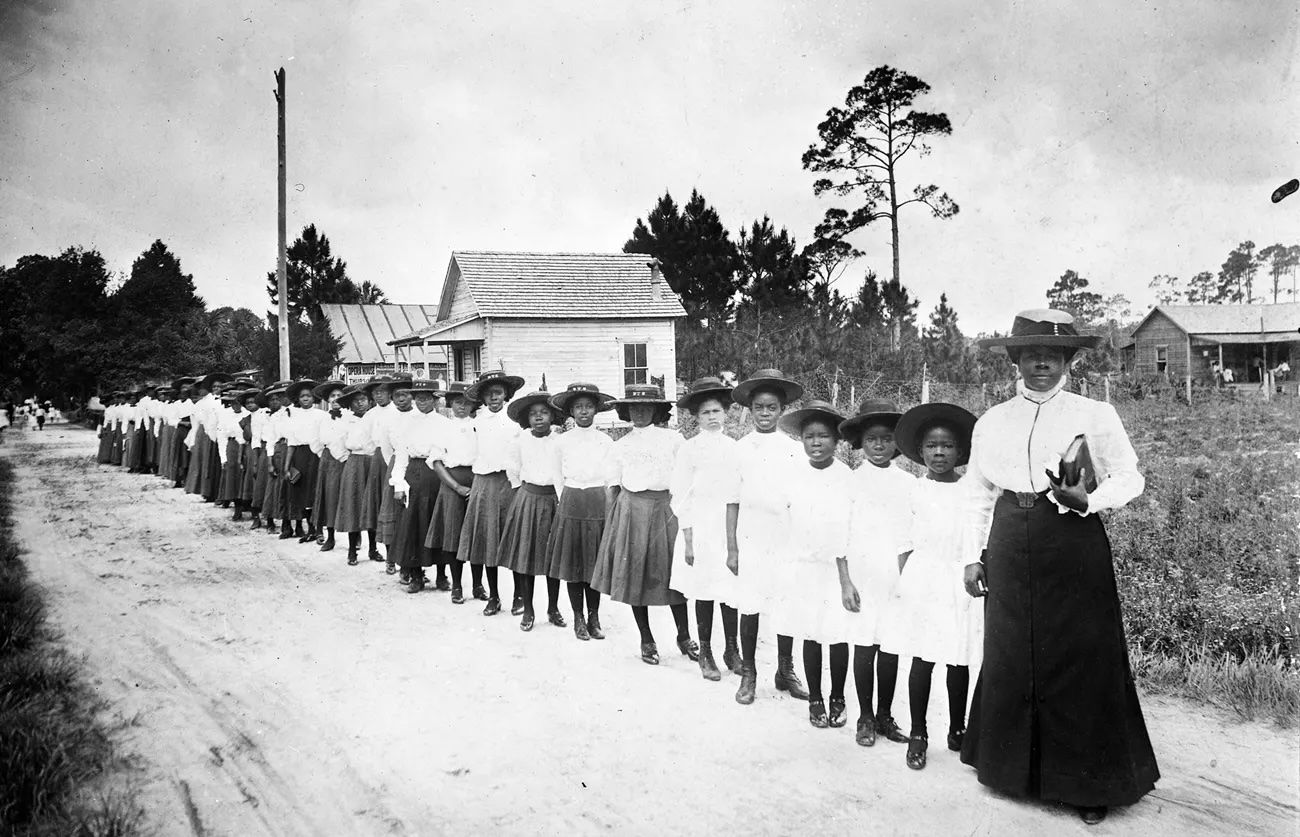
A black and white photograph of Mary McLeod Bethune with her students outside the one-room schoolhouse she founded, the Daytona Normal and Industrial School for Negro Girls, 1905. Photo Source: Library of Congress..
So, after finishing her studies, Bethune returned to the South to teach. She worked at schools in Georgia and South Carolina and married Albertus Bethune, a fellow teacher, in 1898. The next year, their son, Albert McLeod Bethune was born, and the family moved to Florida, where she established a missionary school. Her school grew as her marriage floundered. In 1907, Albertus abandoned the family and returned to South Carolina. Though they never divorced, Mary listed herself as a widow in the 1910 census.
In 1904, at just 29 years old, Mary McLeod Bethune was ready to expand her educational career. With only $1.50 to her name, tremendous faith, and unwavering determination, she established the Daytona Educational and Industrial Training School for Negro Girls in Daytona Beach, FL. She rented a five-room cottage for $11 per month that served as both her family's home and a school. The first class included five girls plus her five-year-old son, Albert. Each student paid fifty cents per week for tuition.
Attendance grew, so Bethune used her earnings to buy land to create a more permanent space to learn. For $250, she bought land that was once the city dump that locals referred to as "Hell's Hole.” The first building, Faith Hall, was built the same year. After nine years of enrollment she expanded again, adding an administrative building with classrooms, offices, and an auditorium. In 1923, Bethune's school merged with the all-male Cookman Institute of Jacksonville to create Bethune-Cookman College. By 1931, the school became fully accredited, and Bethune made history as the first African American woman to serve as a college president. Today, Bethune-Cookman University enrolls over 4,000 students.
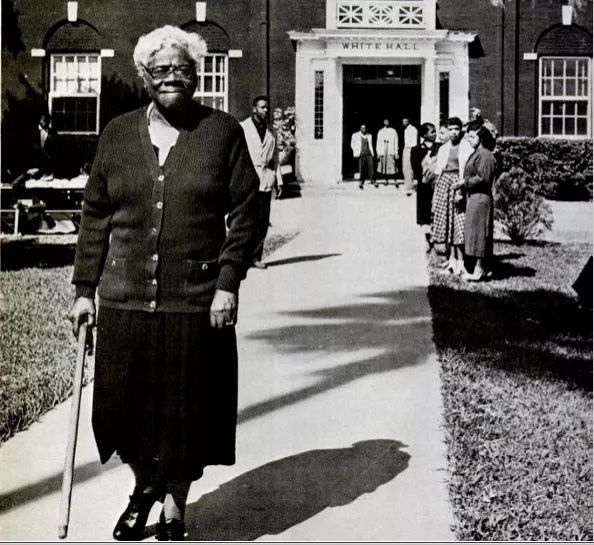
A black and white photograph of Mary McLeod Bethune standing in front of White Hall, a building on the campus of her school Bethune-Cookman College (now University), Daytona Beach, Florida in 1955. Photo Source: Johnson Publishing Company
While building her school, Bethune became involved in women's organizations. She worked with the Florida Federation of Colored Women's Clubs to establish a home for delinquent Black girls in Ocala. She served as president of several organizations, including the Southeastern Federation of Colored Women's Clubs and the National Association of Teachers in Colored Schools. In 1924, she was elected the eighth president of the National Association of Colored Women, managing an organization of 10,000 members with skill and dedication.
In 1935, Bethune founded the National Council of Negro Women to create a national coalition of women's groups focused on social change. Under her leadership, the NCNW grew from 29 founding groups to an organization with over 850,000 members across the country. Today, the NCNW continues her work with over 4 million members.
Bethune's leadership caught the attention of several U.S. presidents. She advised Presidents Calvin Coolidge and Herbert Hoover on various commissions. In 1935, President Franklin D. Roosevelt called her to Washington to serve as a Special Advisor to the National Youth Administration. She impressed him so much that in 1936, at age 61, she became Director of the Division of Negro Affairs, making her the first African American woman to head a federal agency. She also created and led the informal "Black Cabinet," a group of advisors who worked on issues affecting Black communities, including lynching legislation, poll taxes, and job creation.
During World War II, Bethune served as a special assistant to the Secretary of War for the Women's Army Auxiliary Corps, helping establish training schools and recruiting Black women for officer training. She was named honorary General of the Women's Army for National Defense. She also led war bond drives, blood donation drives, and successfully lobbied President Roosevelt to end segregation in veteran rehabilitation centers. After the war, she served as a consultant helping draft the United Nations charter.
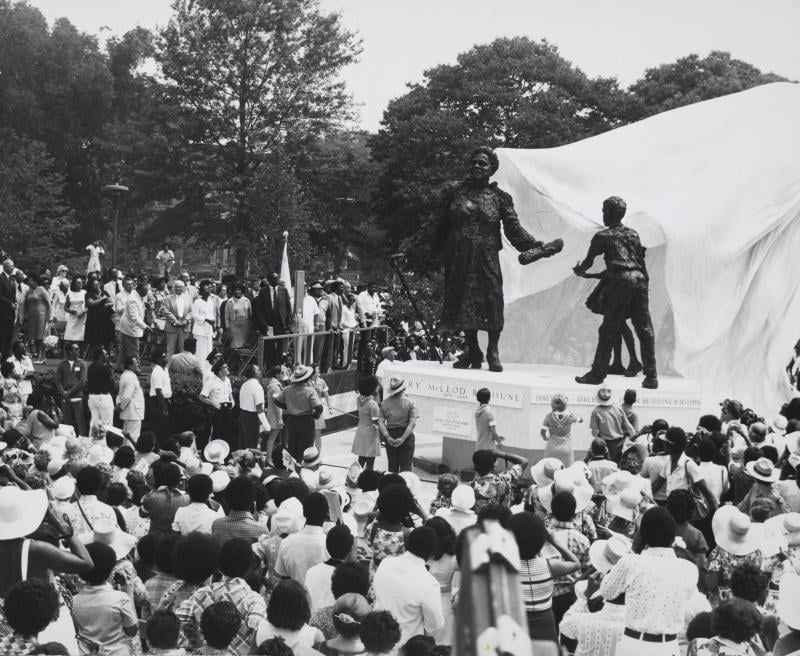
A black and white photograph of a crowd gathering around the unveiling of the Mary McLeod Bethune statue in Washington, DC’s Lincoln Park in 1974. Photo Source: Library of Congress
After Bethune's death on May 18, 1955, the National Council of Negro Women began working to honor her memory. Around 1960, they started a fundraising campaign using small metal donation boxes that featured Bethune's image and her inspiring words about love, hope, education, and faith. In 1974, nearly two decades after her passing, their vision became reality. On the 99th anniversary of Bethune's birth, Dr. Dorothy I. Height and the NCNW unveiled the Mary McLeod Bethune Memorial in Lincoln Park, Washington, DC. Over 18,000 people attended the ceremony. Designed by sculptor Robert Berks, this monument made history as the first memorial to honor an African American and a woman in a public park in the nation's capital.
Bethune's recognition continued to grow in the decades that followed. On July 13, 2022, she became the first African American to have a state-commissioned statue in the U.S. Capitol's National Statuary Hall. The 11-foot marble statue, sculpted by Nilda Comas from Italian marble, represents the state of Florida and replaced a Confederate general. This historic shift toward honoring civil rights leaders rather than Confederate figures symbolizes the enduring importance of Bethune's legacy as an educator and advisor who dedicated her life to justice and equality.
Mary McLeod Bethune's life was a testament to her motto: "faith is the first factor in a life devoted to service." From $1.50 and five students, she built an enduring legacy of education, service, and hope that continues to inspire generations.
Reflection Questions
Think about a goal or dream you have right now. What resources do you already possess—even if they seem small—that you could use to take the first step? How might starting small actually help you learn and grow along the way?Bethune understood that bringing different groups together under one umbrella (like the National Council of Negro Women) created more power than working separately. What issue in your school, workplace, or community could benefit from different groups joining forces?In her last will and testament, Bethune left future generations intangible gifts like hope, education, faith, and responsibility to young people. If you were to write your own "will" of values and principles you want to pass on to others, what would you include?
Learn More
Watch this short documentary on the life and legacy of Mary McLeod Bethune.Lincoln Park, where the Bethune Memorial is located, is rich of Black history. Learn more about its cultural significance in this short article.Watch how Bethune’s hometown celebrated what would have been her 150th birthday last year.The National Council of Negro Women (NCNW) was the first national coalition of African American women's organizations. Learn more about their legacy and ways you can support their work today.
Never miss a story
Get stories of overlooked and untold Black history in your inbox, free every week.