Schomburg Center
The Schomburg Center for Research in Black Culture
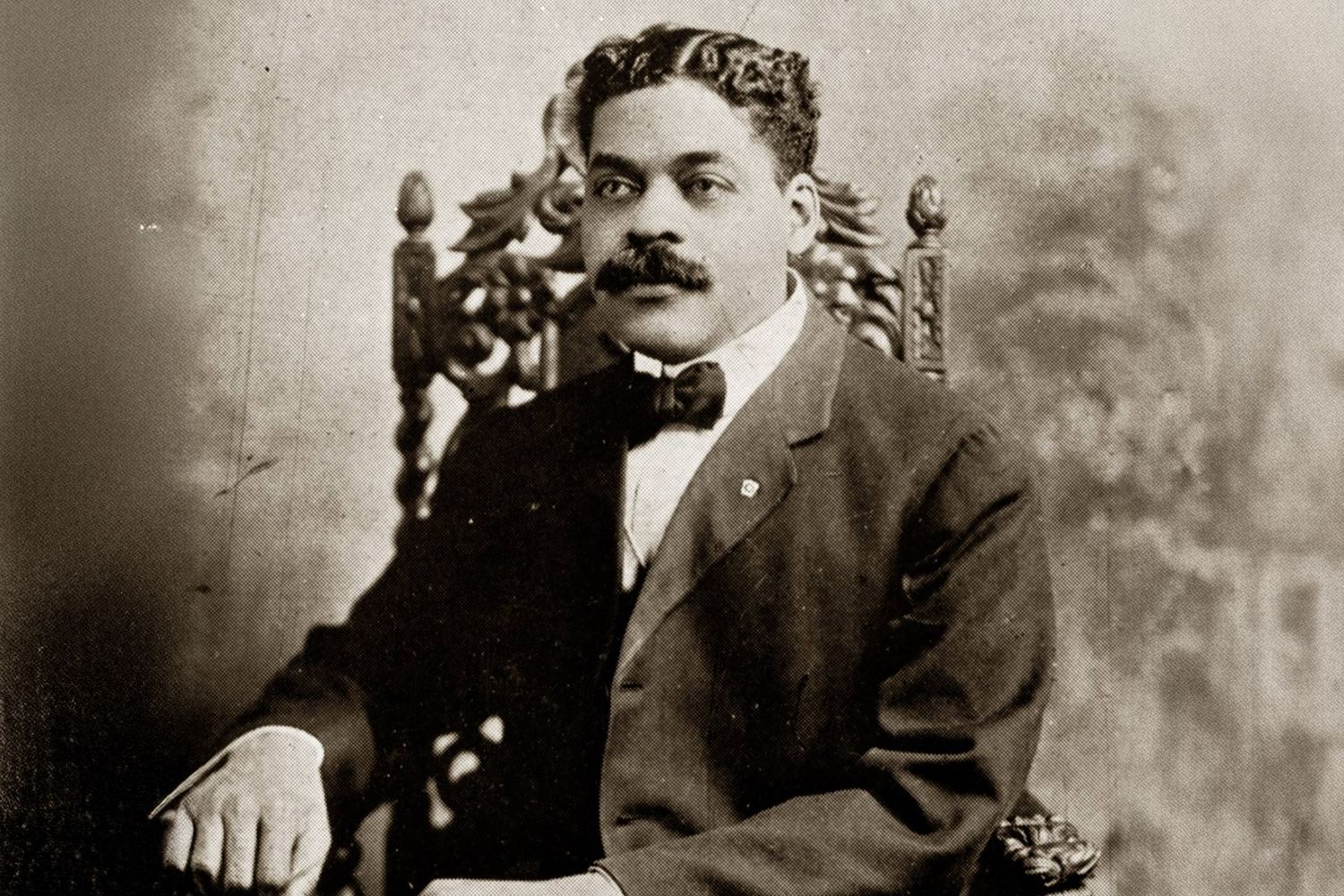
A photograph of Schomburg, center, wearing a suit and bowtie, seated on an elegant chair, posing for a portrait. He has well-styled hair and a large mustache, and is looking away from the camera in solemn contemplation. Photo Source: Photographs and Prints Division, Schomburg Center for Research in Black Culture.
In 1901, Andrew Carnegie donated $5.2 million to build 65 branch libraries across New York City. Among these was a three-story building at 103 West 135th Street in Harlem. Ernestine Rose, a white woman from Bridgehampton, was hired as the branch librarian, and the space opened its doors in 1920.
This was during the peak of the Great Migration, when Black communities moved from the Jim Crow South to the North to find more equitable living conditions and opportunities for fair wages. By 1920, the Black population in Harlem grew to approximately 175,000 people, roughly 32% of Harlem's population, up from under 10% in 1910. It was the largest concentration of Black people in any urban neighborhood in the United States, and was referred to as the "capital of the Black world."
Rose realized that she, her colleagues, and the books in the library didn't reflect this population, and set to change it. She hired Catherine Allen Latimer, the first African-American librarian hired by the New York Public Library system, alongside other Black librarians and staff. Together, they developed programs to bring the community into the space in partnership with schools and social organizations throughout Harlem. Because of this intentional effort, the 135th Street branch became a gathering place for leaders of the Harlem Renaissance and curated events that centered the Black community.
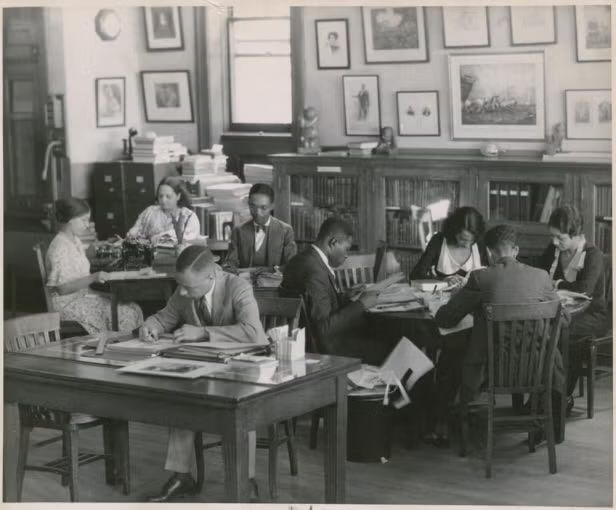
A black and white photograph of a group of people sitting at tables reading and writing at the 135th Street Branch Library Division of Nero Literature, History and Prints, in 1938. Photo Source: Photographs and Prints Division, Schomburg Center for Research in Black Culture.
But there was growing demand to have more artifacts on the shelves created by for the Black community. So, Rose convened a meeting with prominent community leaders, a group known as the "Citizens Committee of the 135th Street Branch Library." This group included James Weldon Johnson, whom we learned about last week, and a man named Arturo Alfonso Schomburg. This group collectively decided to designate the library as the city's Division of Negro Literature, History and Prints. Then, they began reaching out to archivists and collectors to solicit donations to build the collection.
Schomburg was the right person to be at that meeting. As a self-taught historian and collector, he was committed to honoring Black history. He was born in Puerto Rico in 1874 to a Puerto Rican father and an Afro-Caribbean mother, and immigrated to New York at seventeen years of age. Growing up, a grade school teacher in San Juan once told him that Black culture lacked any history worth learning. He chose to dedicate his life to proving them wrong. He had a day job in the mail division at Bankers Trust, and invested all his remaining time and money in building his collection. He did this by making strong connections with artists, intellectuals, and other collectors. He'd ask people to bring things back from their travels, or introduce him to an artist he'd admire, inviting as many people as possible into his pursuit. Through this, he became even more convinced that archiving expressions of Black culture was important for both Black history and Black futures.
"So among the rising democratic millions, we find the Negro thinking more collectively, more retrospectively than the rest, and apt out of the very pressure of the present to become the most enthusiastic antiquarian of them all."
—Schomburg, in an essay published in the March 1925 issue of Survey Graphic.
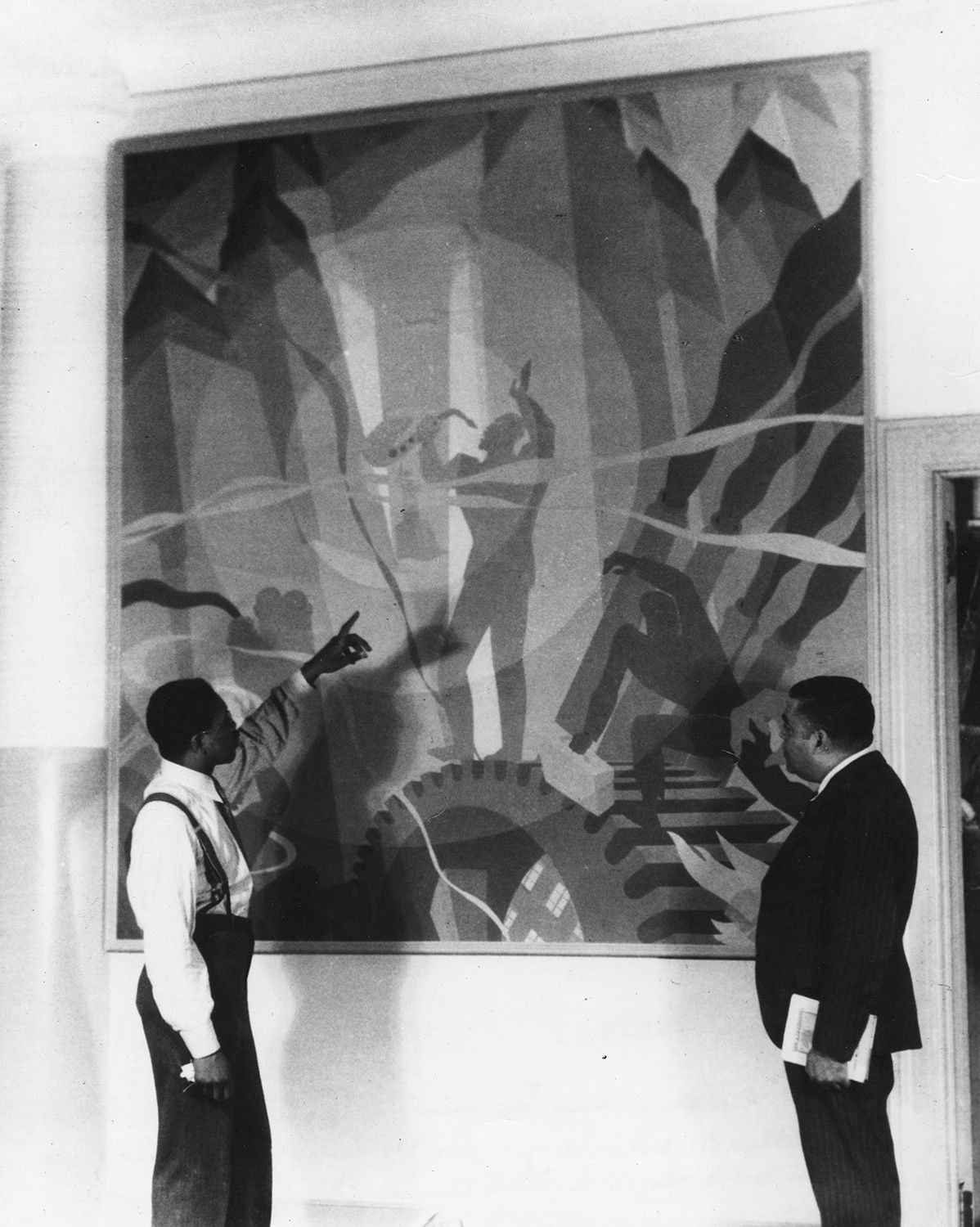
Aaron Douglas (left) discusses his new painting “Song of the Towers” in 1934 with Schomburg Collection curator Arturo Alfonso Schomburg. Photo Source: Photographs and Prints Division, Schomburg Center for Research in Black Culture.
By the time he connected with the library, he had independently collected roughly 5,000 items, including original essays written by Frederick Douglass, poems by Phillis Wheatley, correspondence from Toussaint Louverture, and countless other materials from African Americans and the African diaspora. This was exactly the type of content the library desired to make available to its community.
Schomburg agreed to sell his collection to the library with the guarantee that it would remain in Harlem, always in proximity to the people it reflected. Rose and the National Urban League persuaded the Carnegie Foundation to purchase the collection for $10,000 (valued at nearly $230,000 in today's dollars) and donate it to the library. These new acquisitions helped to transform the division into a major research center.
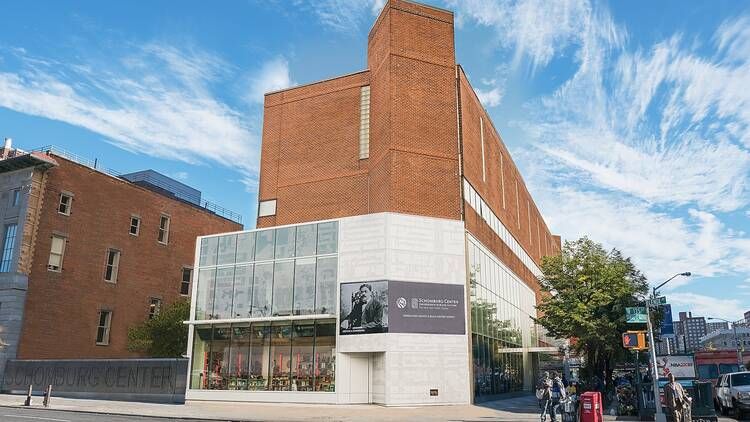
A photograph of the Schomburg Center from across the street against a blue sky with clouds. On the face of the building is a banner with a photograph of Arturo Alfonso Schomburg. Photo Source: Schomburg Center for Research in Black Culture
In 1932, Schomburg himself became the first curator of this collection. He didn't just acquire new artifacts, but hosted public conversations, listened to the needs of the community, and helped shape what the space looks like to this day. When he passed away in 1938, Dr. Lawrence D. Reddick succeeded him as curator. At Reddick's request, the entire division was renamed the Schomburg Collection of Negro History and Literature in 1940. The name was changed again in 1972 to the Schomburg Center for Research in Black Culture to reflect how the use of Negro changed in popular culture. By this time, the collection had ballooned to over 40,000 objects. Schomburg's collection within it had grown to over 10,000 items, including 5,000 volumes, 3,000 manuscripts, and 2,000 etchings.
Today, the Center is known as one of the country's leading archival institutions for African American and Black culture. It's grown beyond its original building on West 135th Street and includes galleries and an auditorium. It curates major exhibitions that have traveled the globe while remaining a steadfast institution in Harlem. In 1981, the original building on West 135th Street was designated a New York City Landmark. As of 2010, it proudly hosts over 10 million objects that reflect the brilliance of Black history.
Reflection Questions
Much of the library’s focus was shaped by the community. How does your community inspire change for the public institutions where you live?Today, many of the artifacts that reflect our culture are on the internet. How do you archive things that you enjoy? Is it online or off?Ernestine Rose, a white librarian, made the strategic decision to integrate her staff and build partnerships with the Black community in 1920s Harlem. How can people in positions of power use their influence to demand change?
Learn More
See how Black August was honored recently in Durham, North Carolina.Read more of George Jackson’s work, including his books “Soledad Brother” and “Blood in My Eye.”Black women–particularly Black trans women–are often overlooked in the movement for racial liberation. Read more about the women who have shaped Black August into what it’s known for today.Join Noname’s Book Club if you want to learn more about Black political resistance and Black liberation.Follow the work of the Malcolm X Grassroots Movement, a group that raises awareness of political prisoners.Watch “The Black August Hip Hop Project,” a 2010 documentary by dream hampton for the NY chapter of the Malcolm X Grassroots Movement.Read “Born in Blood: Death Work, White Power, and the Rise of the Black Guerilla Family”, a book that challenges the official state narrative of the organization.
Never miss a story
Get stories of overlooked and untold Black history in your inbox, free every week.